Worked example · Book indexing
Repair a book index after the pages change
A new proof can split one old page across several destinations. Follow the passage, record the reason and check the references before handing the index back.
Written by Perunlight, the maker of FolioMend, with AI assistance. The original free proof text and CSV were independently checked on 4 October 2026. Screenshots come from the accepted release; the paid app was not rerun for this article. Published .
First, match the printed page labels
Open FolioMend/examples/old.pdf, new.pdf and index.csv from the free pack. “Measuring a Rain Barrel” is an original fictional case. You can complete the exercise without the paid app.
PDF position       1    2    3    4    5    6
Old printed label  i   12   13
New printed label  i   13   14   15   16   17
The new proof’s third PDF page is printed 14. Use the printed label when correcting the index. Keep a separate mapping to the position your PDF viewer displays.
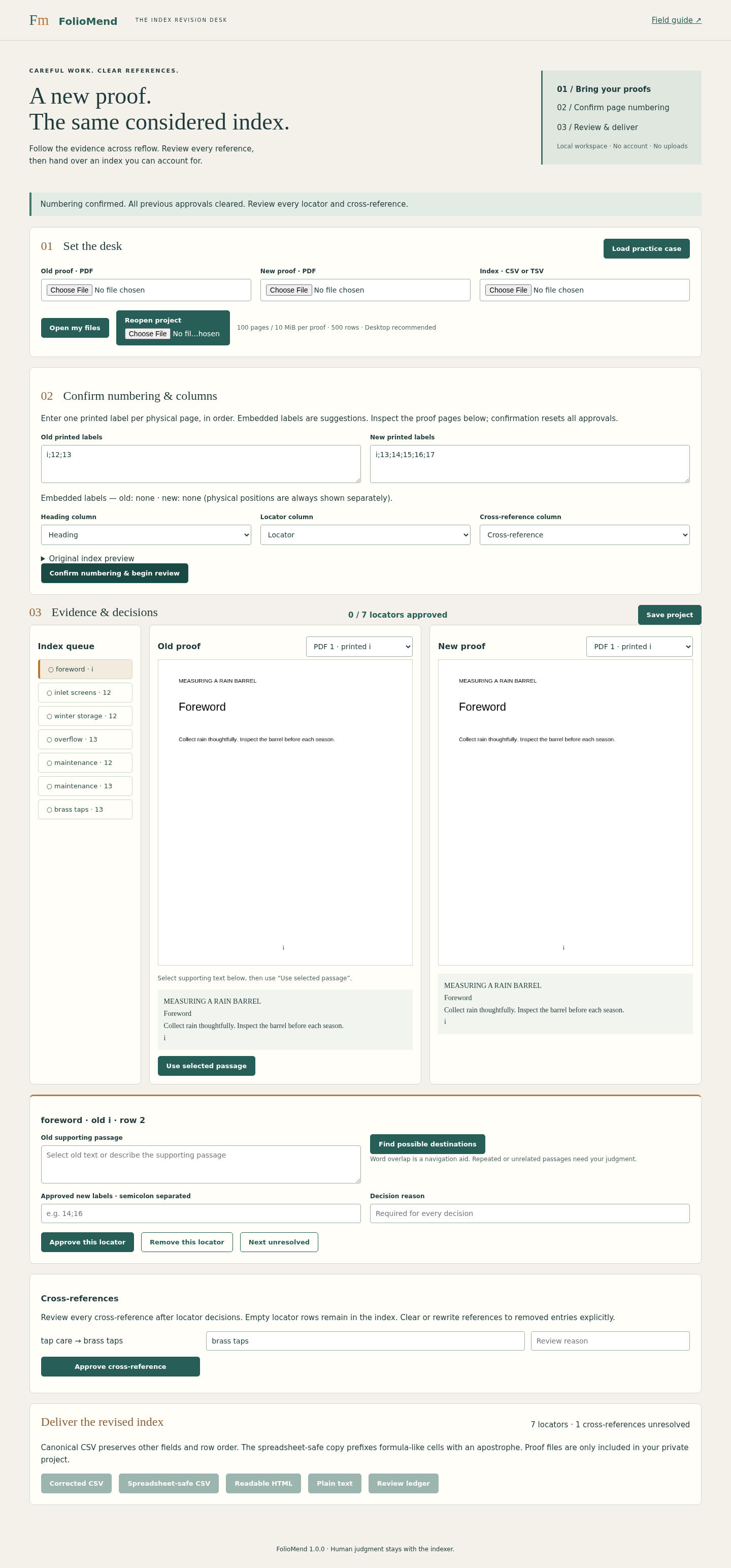
One offset cannot describe this revision
Old page 12 contains two different passages. The inlet-screen sentence moves to 14, while “Drain and disconnect…” moves to 15. Both started on the same old page; adding one fixed number to every old reference would be wrong.
The inlet-screen sentence also appears on 17 in a seasonal summary. Read the surrounding text and choose the main discussion on 14. A matching sentence identifies a candidate; context decides which reference belongs in the index.
The heading winter storage does not appear verbatim in the new body text. Follow its supporting “Drain and disconnect…” passage, under Winter preparation, to 15.
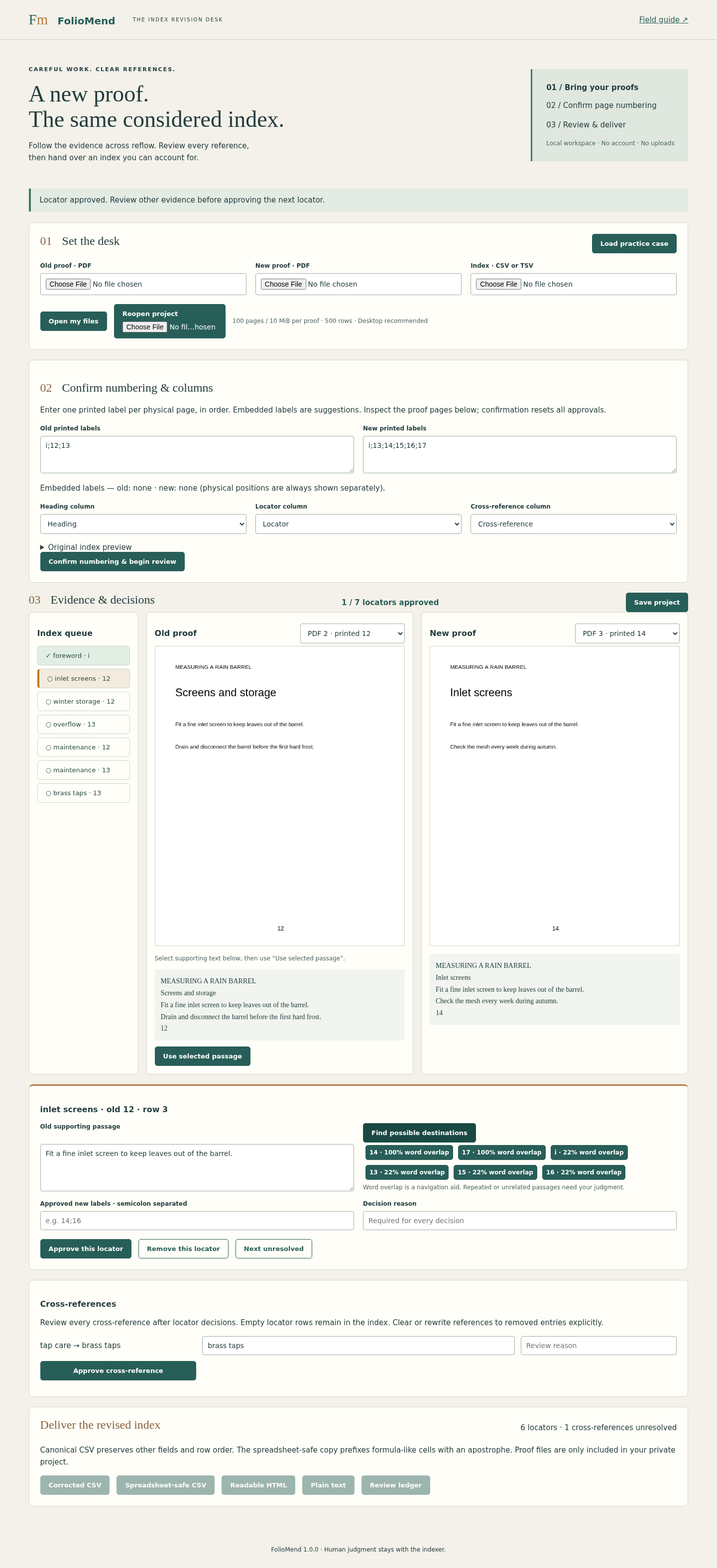
Keep separate destinations separate
The practice index’s maintenance entry uses old 12–13. For this entry, review the screen passage on old 12 and the overflow passage on old 13 separately. Their revised destinations are 14;16. Do not turn those endpoints into 14–16: that would add page 15 without reviewing it as a maintenance reference.
The brass-tap passage is present on old 13 and absent from the new proof. Remove its locator and record why. The source row remains, with an empty locator. Then clear the tap care cross-reference to brass taps; a removed target needs its own review.
Entry             Revised locator
foreword          i
inlet screens     14
winter storage    15
overflow          16
maintenance       14;16
brass taps        [empty]
tap care          [empty; clear brass taps cross-reference]
Compare your result with examples/expected.json. The answer sheet records the intended decisions for this small case; it is not a rule that automatically resolves a real manuscript.
Check the handoff against the passages
- Approve unchanged references too: foreword remains i.
- Record the old supporting passage and a reason for each changed or removed locator.
- Check repeated text in context rather than accepting the first match.
- Preserve separate destinations when a range splits.
- Review cross-references after the locator changes.
- Keep row order and unrelated column values intact.
- Open the actual exported index and compare it with your decisions.
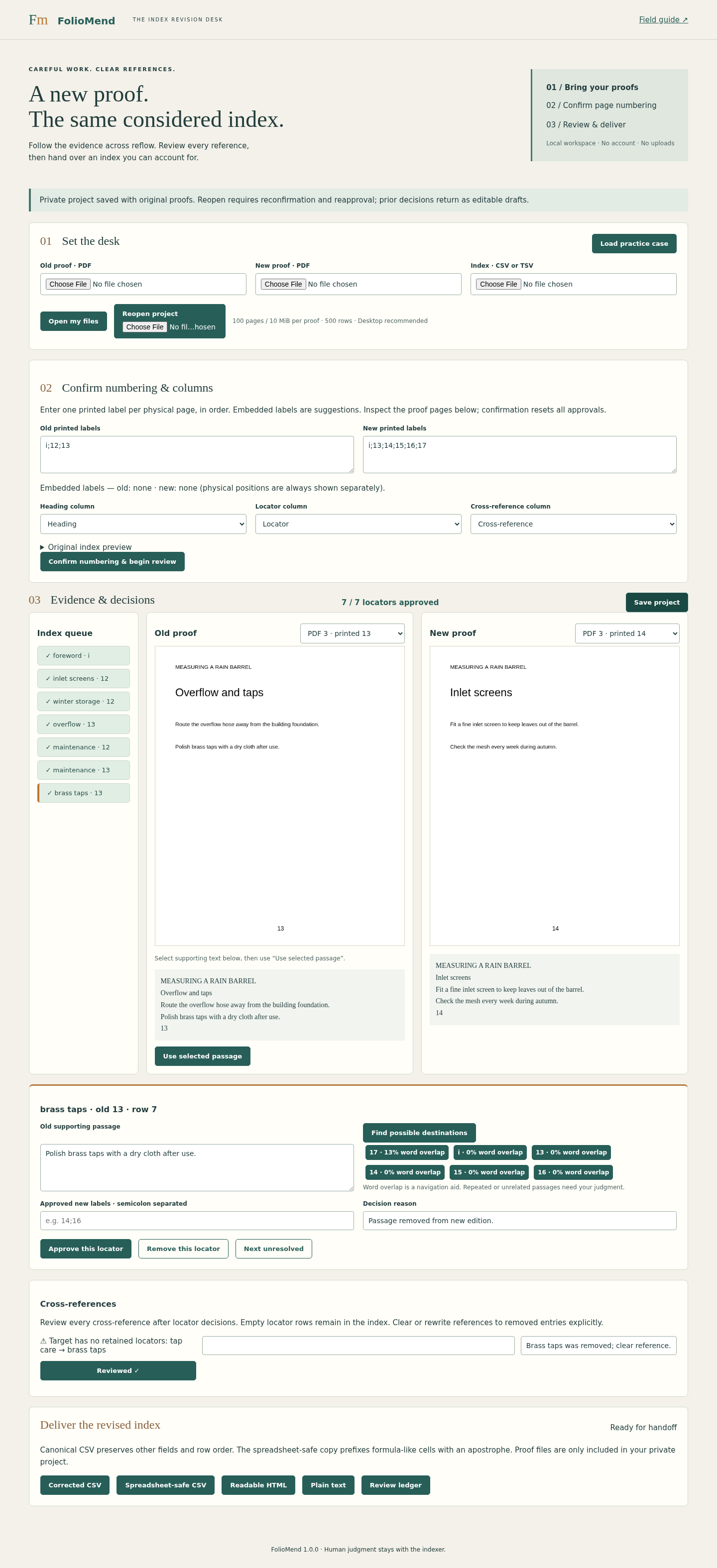
If you use a spreadsheet, review how it interprets the values you open. FolioMend provides a separate spreadsheet-safe CSV; it intentionally differs from the canonical CSV by protecting formula-like cells. Keep the canonical file for a workflow that expects the original strings.
What FolioMend adds
FolioMend is a $29 one-time local application for revising an existing CSV/TSV index against two text-PDF proofs. It shows old and new passages, ranks possible destinations by word overlap, requires an explicit decision for each locator and exports the corrected index plus a review ledger. Read the full manual for launch and delivery instructions.
- Python 3 and desktop Chrome are required. Extract the buyer pack and run its local launcher; opening the app HTML directly will not work. Independently verified on Linux only.
- Up to 100 physical pages and 10 MiB per proof, 500 index rows and 1,500 expanded locators. Every PDF page must contain extractable text; no OCR, scans or blank pages.
- Arabic labels 1–9999 and lowercase Roman i–xxx; full ranges and semicolon lists. No abbreviated ranges, page suffixes, duplicate printed labels or native Cindex/SKY import.
- Each locator and cross-reference still needs human judgement. Outputs are not publisher-specific typesetting.
- Save projects explicitly. There is no autosave or undo; reopening restores decisions as drafts for reapproval. Private project files contain the original proofs.
The free pack contains the illustrated manual and the complete fictional exercise. The paid application is not needed to follow the reasoning on this page.
Perunlight product
Try the small case before buying
Use the free proofs to decide whether this is the revision problem you need to solve. FolioMend adds a local review desk and an exportable record of your decisions.
See FolioMend · $29 one-timeRead the manual
Purchased version only; future major upgrades are not included. Python 3 and desktop Chrome are required; verified on Linux only.