Step-by-step guide
ForsetiFest
Order your selected films, place screenings and keep each issued program together.
Use it when film runtimes, block order or screening times change and the audience program and staff timings need to stay in step.
Before you start
- Desktop Chrome that can open extracted local HTML files; Chrome 152 on Linux was verified.
- A selected film list with stable IDs and exact mm:ss runtimes.
- Your own festival dates, rooms and local-time label.
Your first result
Open Harbor Lights
Extract the complete ZIP and open app/ForsetiFest.html. Load Harbor Lights to inspect an original ten-film example across two rooms and three dates.
Bring your selected films
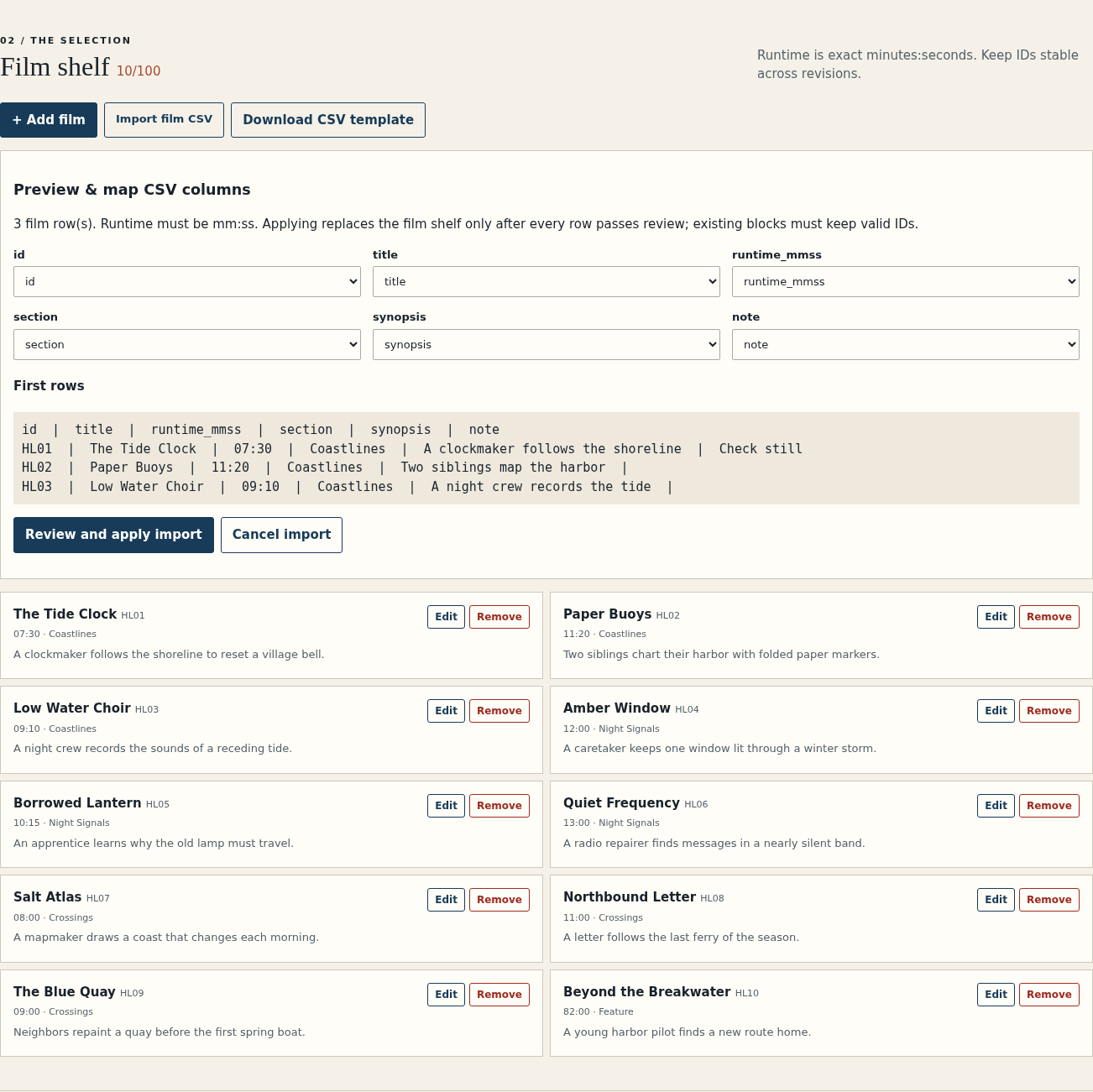
Start a project, name the rooms and set dates. Import a film CSV, preview and map its columns, then apply it. You can also add and edit films directly.
Build the blocks
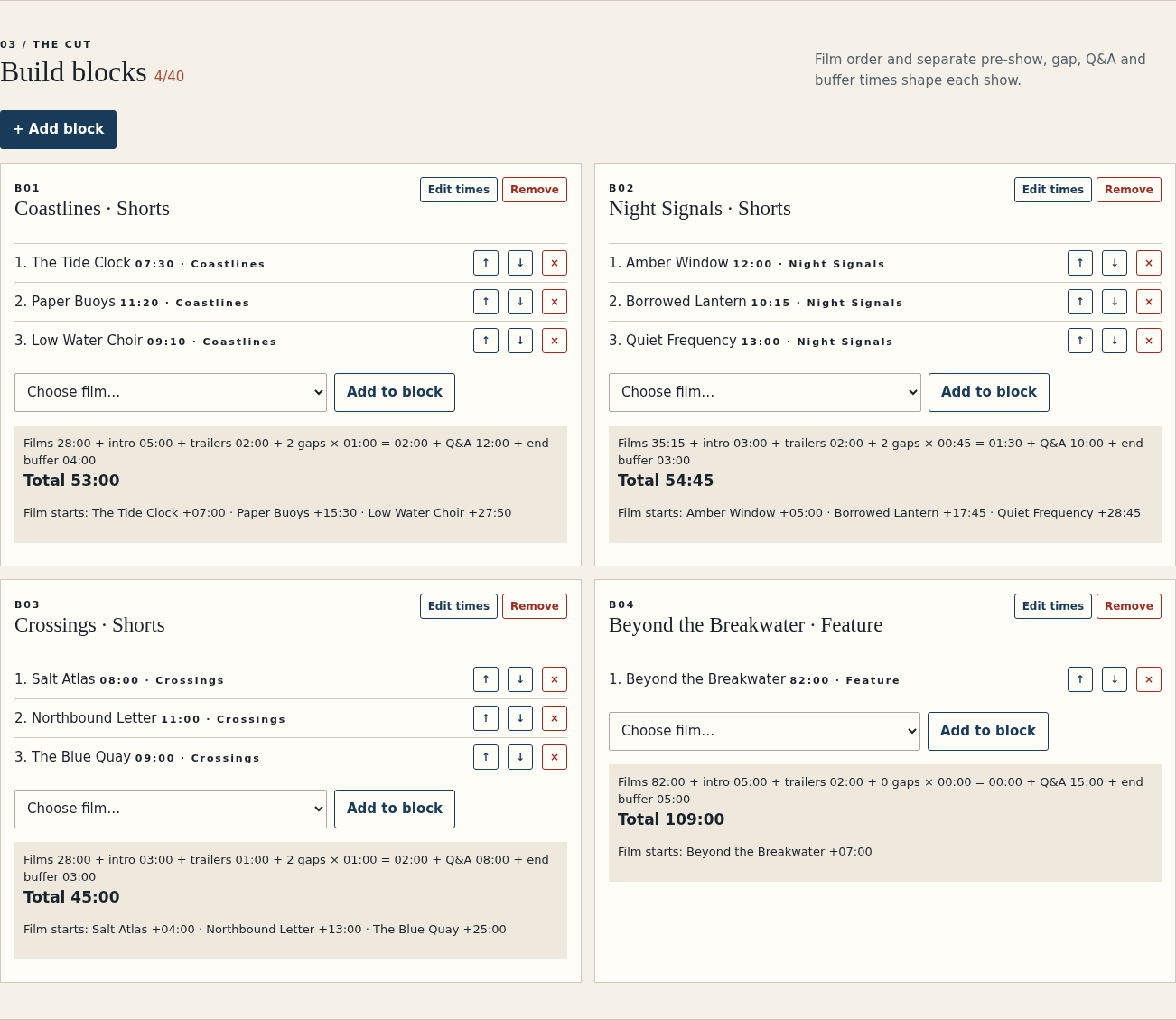
Add films to each block and arrange their order with the arrow controls. Set introduction, trailer, between-film gap, Q&A and end-buffer durations separately.
Place screenings and resolve issues
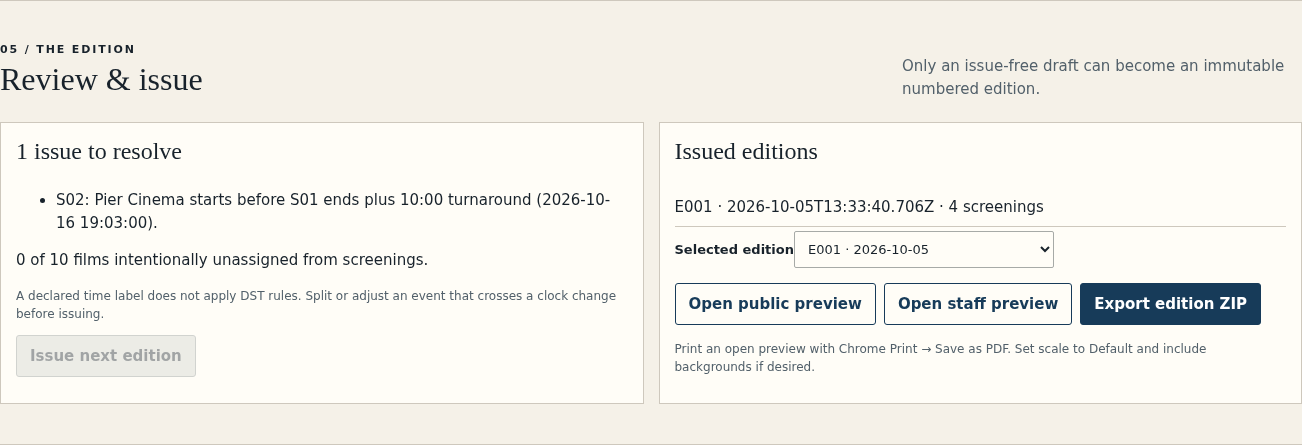
Set each screening date, room, start and latest finish. Review overlaps, room turnaround and intentional repeats before issuing.
Issue and retain matching editions
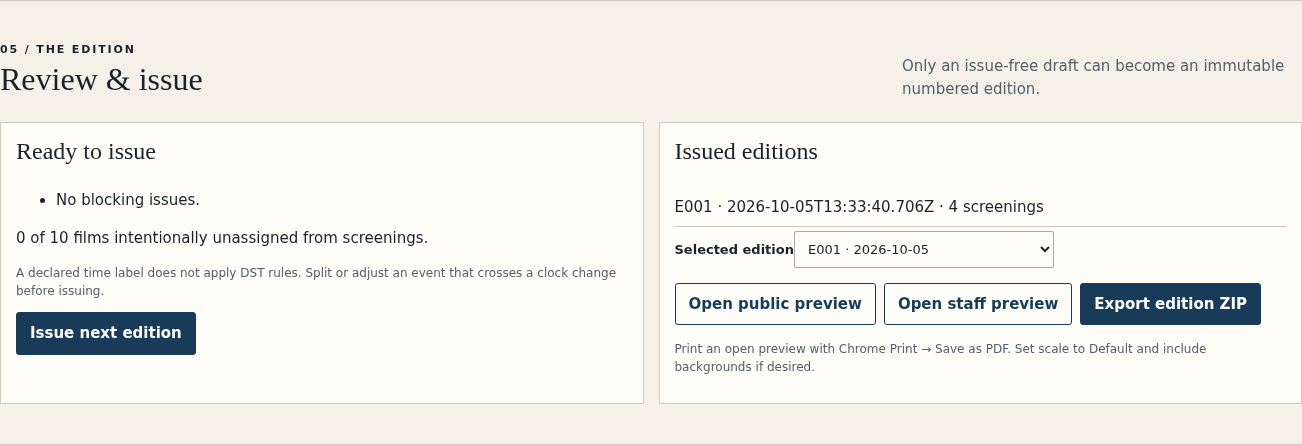
Issue a numbered edition and export its audience program, staff run sheets, schedule CSV, edition JSON and revision report. Save project retains the draft and prior editions. Print an HTML preview through Chrome Print or Save as PDF.
A worked example
A 53-minute shorts block
Input: Coastlines contains films of 7:30, 11:20 and 9:10, totaling 28 minutes.
- Load Harbor Lights and inspect the first block.
- Check intro 5:00, trailers 2:00, two gaps of 1:00, Q&A 12:00 and end buffer 4:00.
- Open the staff preview and export edition E001.
Expected result: The block lasts 53:00. An 18:00 screening ends at 18:53; with ten minutes of room turnaround, the next screening can start at 19:03. The exported files share the same edition snapshot.
See the real workflow
Screenshots from the included fictional example in the tested Chrome environment.
1. Build a block with explicit timing
2. Preview and map a film CSV
3. Resolve a scheduling conflict
4. Issue a numbered edition
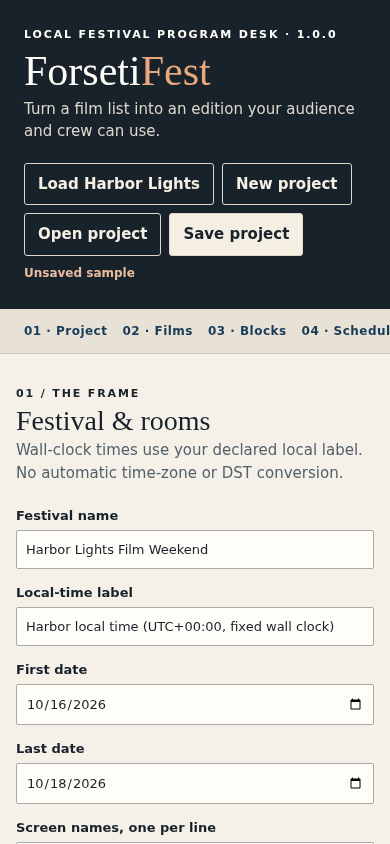
5. Review at a narrow width
Troubleshooting
A film CSV cannot be applied
Map the required ID, title and runtime columns. Use mm:ss, unique IDs and consistent CSV columns. An import must preserve IDs already used by blocks.
The next screening is blocked
Compare its start with the previous screening end plus room turnaround. Also check the explicit latest finish and any undeclared repeat.
An old edition does not show a draft change
Issued editions are fixed snapshots. Resolve issues and issue a new edition to include the change, then select that edition for export.
A festival crosses a daylight-saving change
The local-time label does not apply time-zone rules. Explicitly split or adjust the event schedule before issuing.
Compatibility & limits
- 100 films, 40 blocks, 60 screenings, 4 rooms, 14 inclusive days, 1 MiB CSV and 8 MiB project JSON. Wall-clock time only; no automatic timezone or DST conversion. No ticketing, rights checks, media ingest, collaboration or direct festival-platform import.
- Starts from a selected film list. It does not handle submissions, ticketing, rights clearance, media playback or DCP delivery.
- Wall-clock arithmetic uses one declared local label; it does not apply automatic time-zone or daylight-saving conversion.
- Browser printing was verified; physical printers, projectors and other browsers were not verified.
Need a hand?
Tell us the product, host application and version, what you tried, and the exact error. Contact support with a fictional example; keep private customer files and passwords out of your message.