Step-by-step guide
HodrBoard
Turn finished PDF, PNG and JPEG competition boards into consistently named JPEGs that meet your sheet size, resolution and file limits. Review the boards, then download an upload ZIP and a separate private receipt.
A competition accepts JPEG boards and you need to meet explicit pixel, file-size and naming requirements before making your own final anonymity check.
Before you start
- Desktop Google Chrome; Chrome 152 on Linux was tested. Extract the whole buyer ZIP before opening HodrBoard.html.
- The actual competition brief and your finished PDF, PNG or JPEG boards. Keep original design files.
- Read the input and output limits before buying. This application does not edit your layout or automatically remove visible identity.
Your first result
Open the fictional example
Extract the complete buyer ZIP and open HodrBoard.html in desktop Chrome. Choose Load the Lantern Pier example. Its brief and three original boards load together.
Read the brief and findings
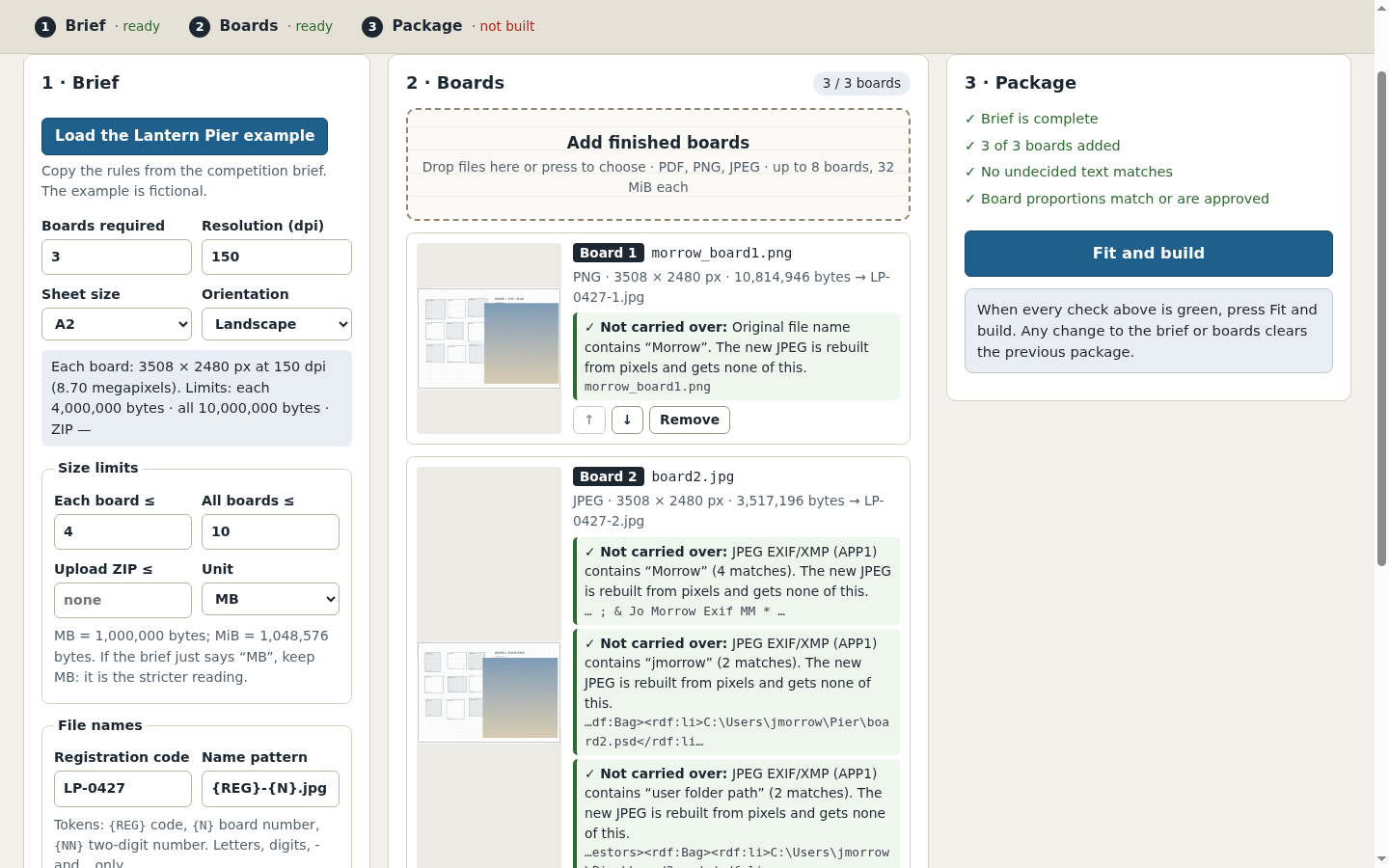
The example requests three A2 landscape boards at 150 dpi, code LP-0427, a 4 MB limit per file and a 10 MB limit across the JPEGs. Look at the reported original names and metadata. These findings belong in the private receipt.
Fit the example
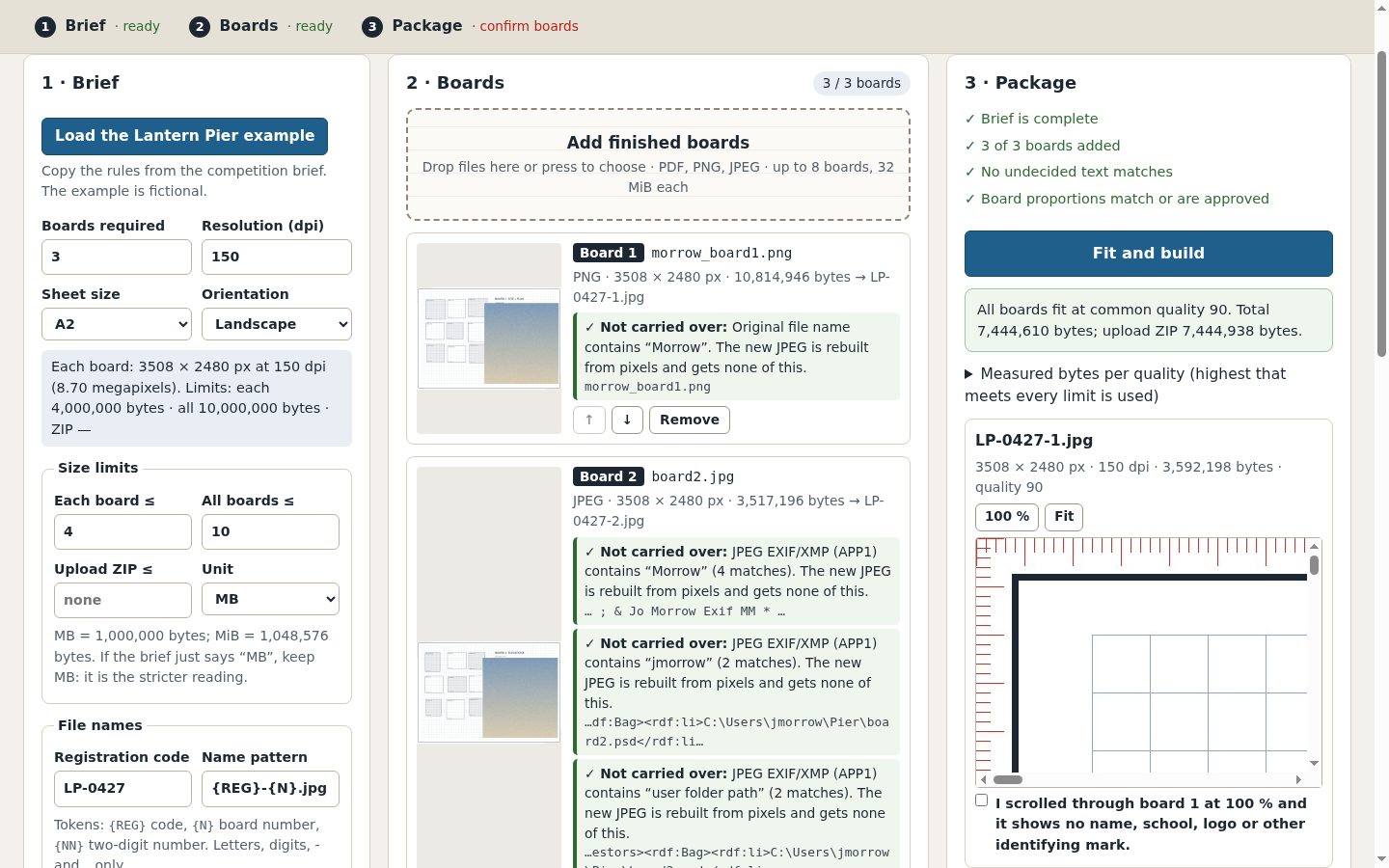
Choose Fit and build. Each output is 3508 × 2480 pixels. The application measures qualities 95 through 50 and selects one common quality that satisfies every active limit. The tested example uses quality 90.
Inspect at full size
Scroll each board’s 100 % viewer. Inspect small labels, linework, margins and visible identity. Tick its confirmation only when the result is suitable. Read and tick the acknowledgement about raster text and the brief.
Save the two kinds of output
Choose Download upload ZIP for the renamed JPEGs. Download the PRIVATE receipt separately; it contains HTML and JSON records of settings, original names, findings and hashes. Keep it yourself and never include it in a competition upload.
Enter your own requirements
Start with the actual competition brief. Enter sheet size, orientation, dpi and board count; set per-board and combined-file limits, and a ZIP limit if required. Choose MB or MiB to match the brief. Set the registration code and file-name pattern, then save a PRIVATE brief.
Add and review your own boards
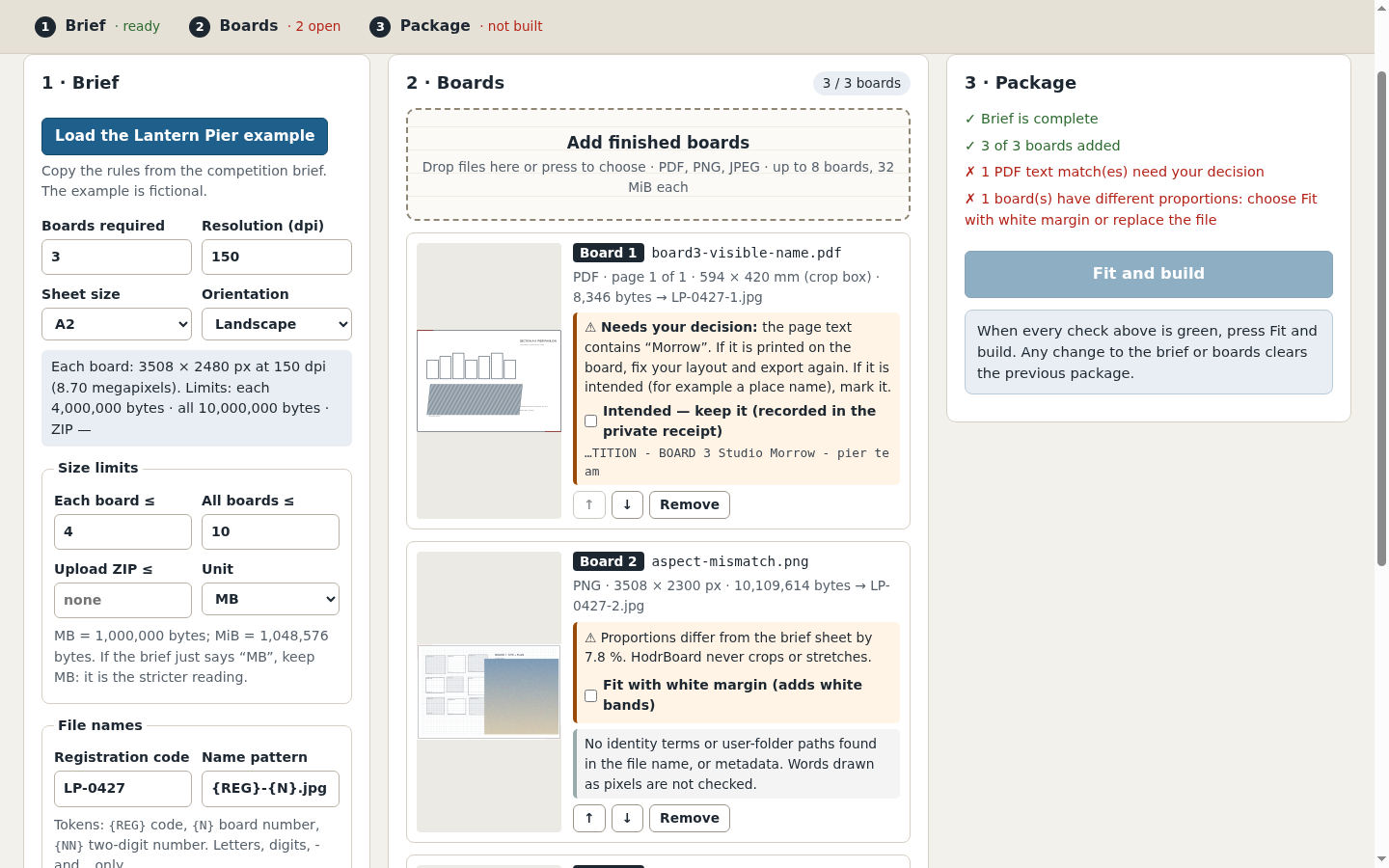
Add supported finished files and put them in the required order. Choose the required page for a multi-page PDF. Enter relevant names, school, studio and folder terms. A PDF text match needs a decision; fix the original layout if the text should be removed. Text drawn as pixels is not searched.
Resolve proportions and size limits
If sheet proportions differ, replace the file or explicitly choose Fit with white margin. The application never crops or stretches it. If no quality fits, check units and caps or revise the source; lower dpi only if the brief permits it.
Build again after changes
Changing the brief, order, page or review decision clears the previous package. Rebuild, inspect every board again and save the final files. Compare the result with the actual brief before submitting.
A worked example
Three fictional Lantern Pier boards
Input: Original practice PNG, JPEG and PDF boards with fictional identity in file names or metadata, a matching brief, and separate practice files for visible identity and unsupported PDF layers.
- Load the example and review the brief and findings.
- Fit and build, then inspect all three boards at 100%.
- Save the upload ZIP separately from the PRIVATE receipt.
Expected result: LP-0427-1.jpg, LP-0427-2.jpg and LP-0427-3.jpg, each 3508 × 2480 at 150 dpi. The tested Chrome run chose quality 90 and produced about 7.44 MB of JPEGs. The ZIP contains only these boards; the private receipt retains original names and findings. This is a fictional workflow example, not proof of competition acceptance.
From the brief to the upload package
Actual application screens using original fictional Lantern Pier files.
1. Inspect the boards before downloading
2. See what the files contain
3. Make the unresolved decisions
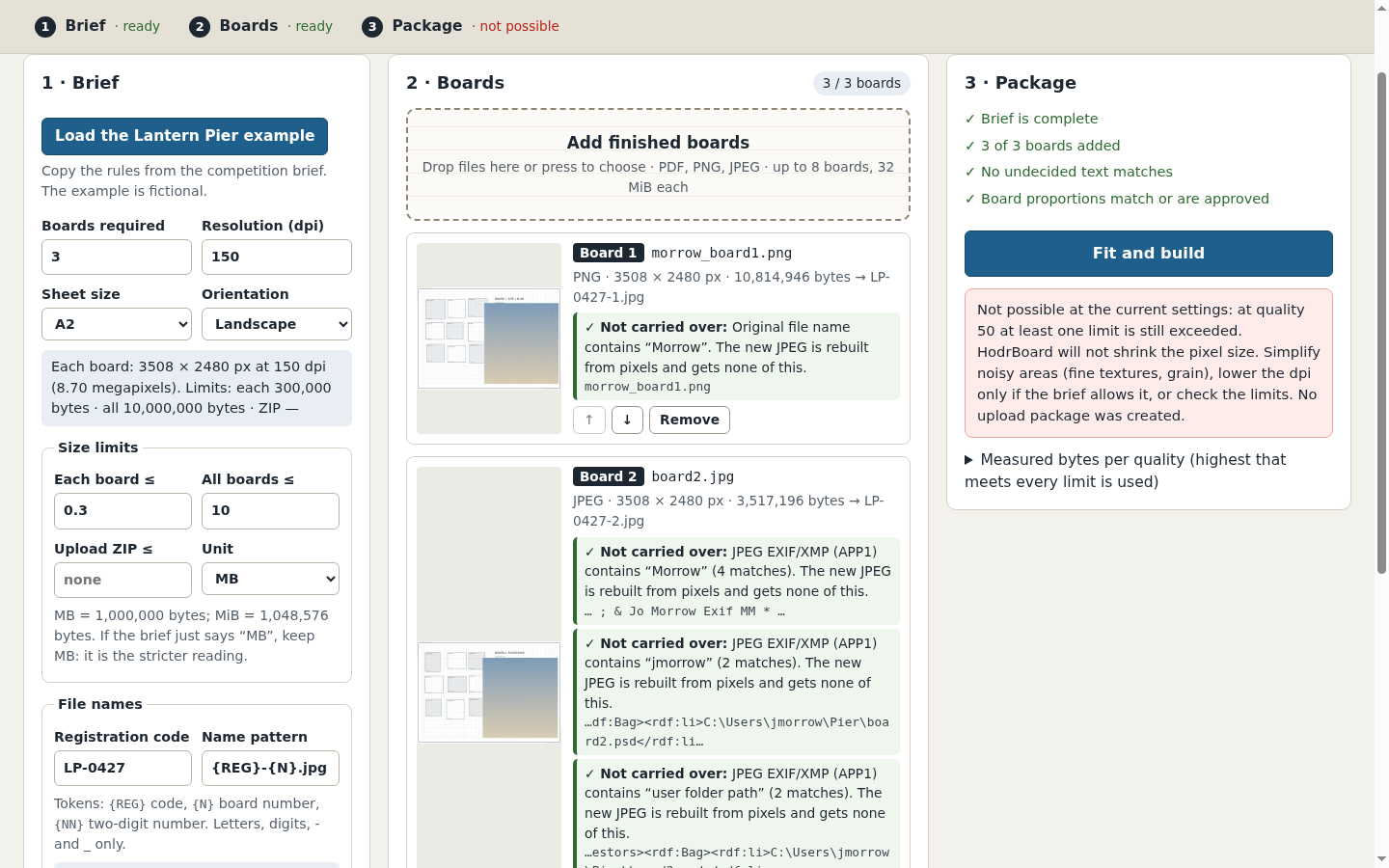
4. Know when the limits cannot be met
Troubleshooting
A PDF contains layers, fields or annotations
Return to the layout application and export a flattened PDF without these features, or export a supported PNG/JPEG. Keep the original.
A colour profile or rotated image is refused
Convert a working copy to supported, upright sRGB pixels in an image editor. Simply removing a colour profile is not colour conversion. Check the full input restrictions below.
A name is visible on the board
Fix it in the original layout and export again. HodrBoard does not redact visible content. An intended text match can be recorded as such, but this does not establish anonymity.
The selected size and dpi exceed the pixel limits
Check all stated pixel limits together. Use a resolution allowed by the brief or choose a tool that supports the required size; do not silently lower the requirement.
No quality meets the file limits
Check MB versus MiB and whether the brief limits individual files, their sum or the ZIP. Revise dense textures or the source layout. Lower dpi only when permitted.
Download buttons are disabled
Resolve all decisions, complete the build, inspect and confirm every board, then tick the acknowledgement. Any later change requires another build and review.
Fine labels or lines look wrong
Export with fonts embedded, inspect the exact rebuilt JPEG at 100%, and compare it with your source. PDF rasterisation and JPEG compression can affect fine detail.
Compatibility & limits
- Enter the rules from your own competition brief. HodrBoard does not check a competition website, submit files, or guarantee acceptance or anonymity.
- No OCR or automatic visual redaction. Text, names, logos and signatures drawn as pixels are not detected. Review every board at 100% yourself; a text-search result is only a review aid.
- Up to eight boards, 32 MiB per input file, 128 MiB total input, 24 million pixels and 8192 pixels per side per source and output board, and 96 million output pixels in total. All limits apply together. A1 at 150 dpi is within the output limits; A2 at 300 dpi is not.
- Inputs: PDF, opaque 8-bit RGB/grey PNG, baseline/progressive RGB/grey JPEG, upright, untagged or sRGB (an embedded colour profile is judged by its measured colours, not its name). CMYK, 16-bit, indexed, alpha, animated, HDR/wide-gamut, other colour profiles and files tagged as rotated or mirrored (EXIF, also in PNG) are refused
- JPEG output only, at one common quality selected from 95, 90, 85, 80, 75, 70, 65, 60, 55 or 50. The application uses the highest tested quality meeting every byte limit. It never lowers the pixel dimensions to make a file fit.
- MB means 1,000,000 bytes and MiB means 1,048,576 bytes. The total-file limit and optional ZIP limit are separate; ZIP headers count toward the ZIP limit.
- PDF page selection respects the crop box and page rotation. PDFs with layers, encryption, signatures, forms/XFA or page annotations are refused. Non-embedded fonts may be substituted; export with embedded fonts and inspect fine labels and lines.
- A proportion difference above 0.5% requires your explicit choice to fit with white margins. Boards are never automatically cropped or stretched.
- The upload ZIP contains only renamed JPEGs. The separate PRIVATE brief and receipt contain your entered terms, original file names, findings and hashes; keep them yourself and do not submit them.
- Tested in desktop Chrome 152 on Linux. Other browsers, Windows, macOS and actual mobile devices are unverified. The 390-pixel layout was inspected in a desktop browser. The output is intended for screen submission, not a print colour proof.
- The fictional example demonstrates the workflow; no real competition submission or buyer outcome was tested. Exact JPEG byte counts can vary with Chrome versions; limits are checked against the files actually produced.
Need a hand?
Tell us the product, host application and version, what you tried, and the exact error. Contact support with a fictional example; keep private customer files and passwords out of your message.