DomovoiTray · Worked example
Check the lid space before you cut the insert
A tray can fit the box floor and still keep the lid from closing. Work through the component measurements, board thickness and everything that sits above the trays before planning your cuts.
By Perunlight · AI-assisted. Original fictional project; the example dimensions and height stack were independently recalculated. Published .
Start with measured components and the inner box
Open samples/lantern-ferry.json and EXPECTED-RESULTS.md in the free pack. The inner box is 290 × 290 × 70 mm. The example uses 5 mm board, 1 mm clearance on each side of a component and 2 mm headroom above the tallest fill.
The two sleeved decks have the same 66 × 91 mm footprint. The Ferry deck contains 110 cards; the Harbour deck has 60. At 0.40 mm per card, their fills are 44 and 24 mm. The token pile measures 58 × 58 mm and is 30 mm tall.
Requested wells (width × depth)
Ferry deck:    (66 + 2 × 1) × (91 + 2 × 1) = 68 × 93 mm
Harbour deck:                               68 × 93 mm
Token pile:   (58 + 2 × 1) × (58 + 2 × 1) = 60 × 60 mm

Ferry fill:   110 × 0.40 = 44 mm
Harbour fill:  60 × 0.40 = 24 mm
For your own game, measure the sleeves and a real card stack. Enter the inner box size and actual board thickness. The tool works with the numbers you supply; it cannot find an omitted component or an inaccurate measurement.
Include every wall and the shared well depth
These three wells share one row. Four vertical pieces — two end walls and two dividers — add to the three well widths. Two long walls add to the deepest well. The base sits under the tallest fill and its headroom.
Length: 5 + 68 + 5 + 68 + 5 + 60 + 5 = 216 mm
Depth:  5 + 93 + 5                   = 103 mm
Height: 5 + 44 + 2                   =  51 mm

Actual token well: 60 × 93 mm
Requested token well: 60 × 60 mm
The token compartment becomes deeper than requested because every well uses the same inner depth of 93 mm. Inspect the actual well dimensions before relying on the layout. If you need a different depth, put that component in another tray.
Add the board and rulebook before judging the fit
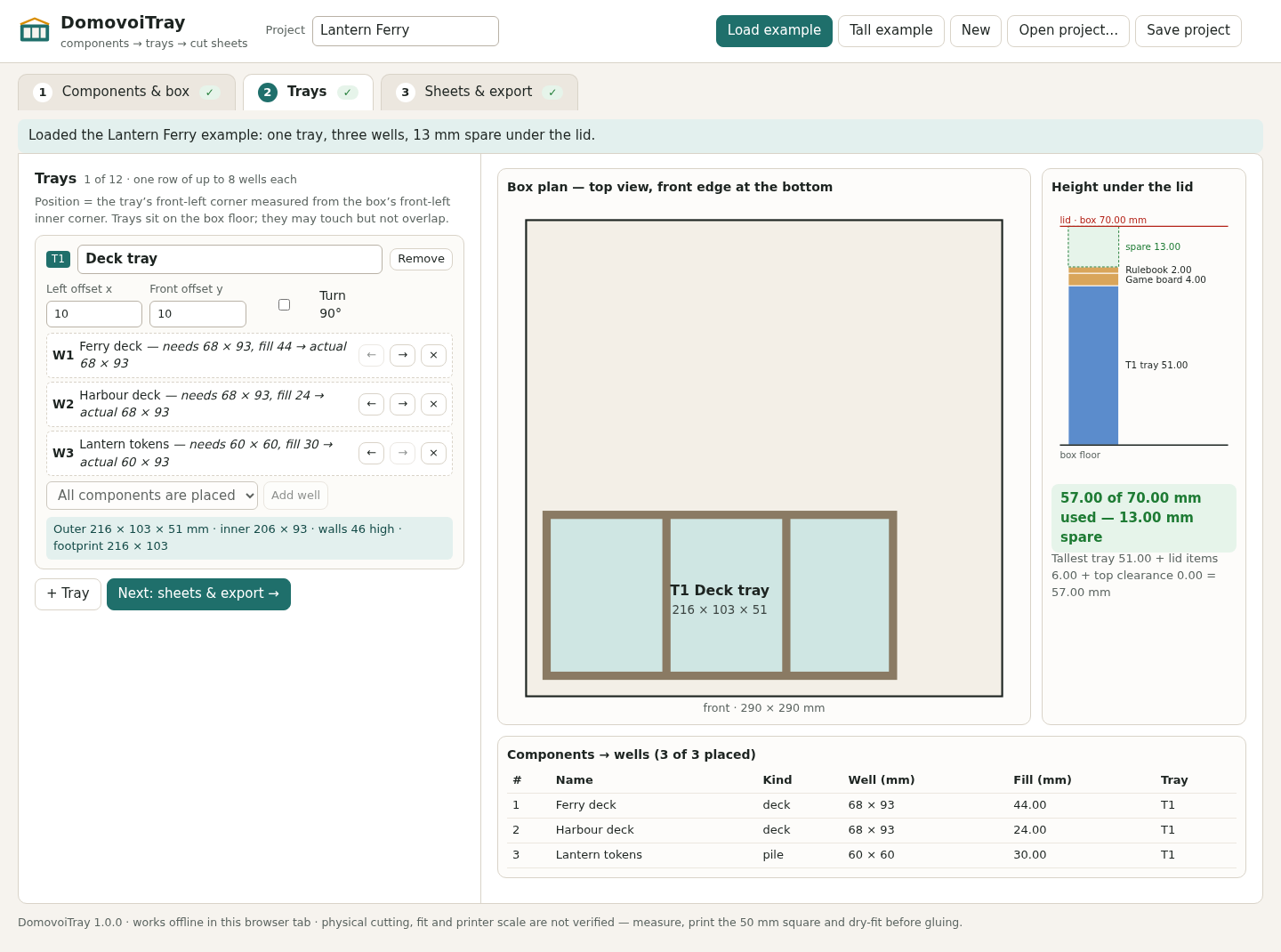
The tray is only part of the stack. Lantern Ferry also places a 4 mm game board and a 2 mm rulebook above it. Top clearance is set to zero in this exercise.
Tray + board + rulebook + top clearance
 51  +   4   +    2     +      0        = 57 mm used
70 mm box − 57 mm stack                = 13 mm spare
Now open samples/lantern-ferry-tall.json. The only larger component is the Ferry deck: 150 cards × 0.40 mm = 60 mm of fill. The tray becomes 5 + 60 + 2 = 67 mm tall. With the board and rulebook, the stack reaches 73 mm, exceeding the box by 3 mm.
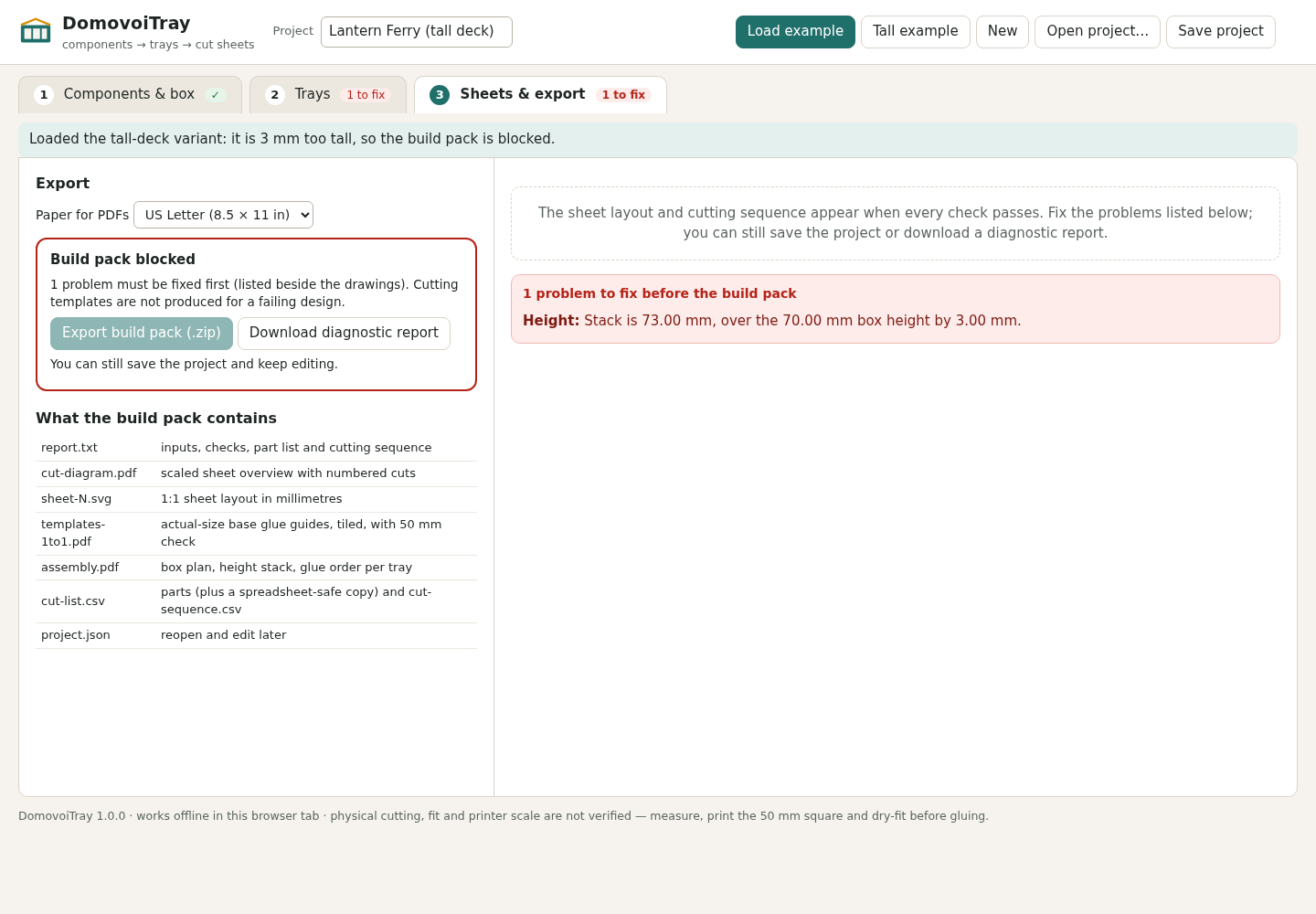
In the paid app, Tall example shows that exact refusal. The build pack, sheet layout and cutting sequence are withheld until all checks pass. You can still save the project and download a diagnostic report. Adding a larger paper sheet will not fix a height problem; change the measured arrangement or box instead.
Read the seven parts and the sequence before cutting
For the normal tray, the wall height is 44 + 2 = 46 mm. The base is the full 216 × 103 mm footprint; the end walls and dividers fit between the two long walls.
1 base:                  216 × 103 mm
2 long walls:            216 ×  46 mm each
2 end walls + 2 dividers:  93 ×  46 mm each

7 parts; total rectangle area = 59,232 mm²
500 × 700 mm sheet area       = 350,000 mm²
Part area / sheet area       = 16.92%
The free EXPECTED-RESULTS.md gives the 13-cut reference sequence for a 500 × 700 mm sheet, 5 mm margin and 0.5 mm kerf. The shelf layout is deterministic, not an optimizer. Its part-area percentage excludes kerf and waste; it does not measure total usable material.
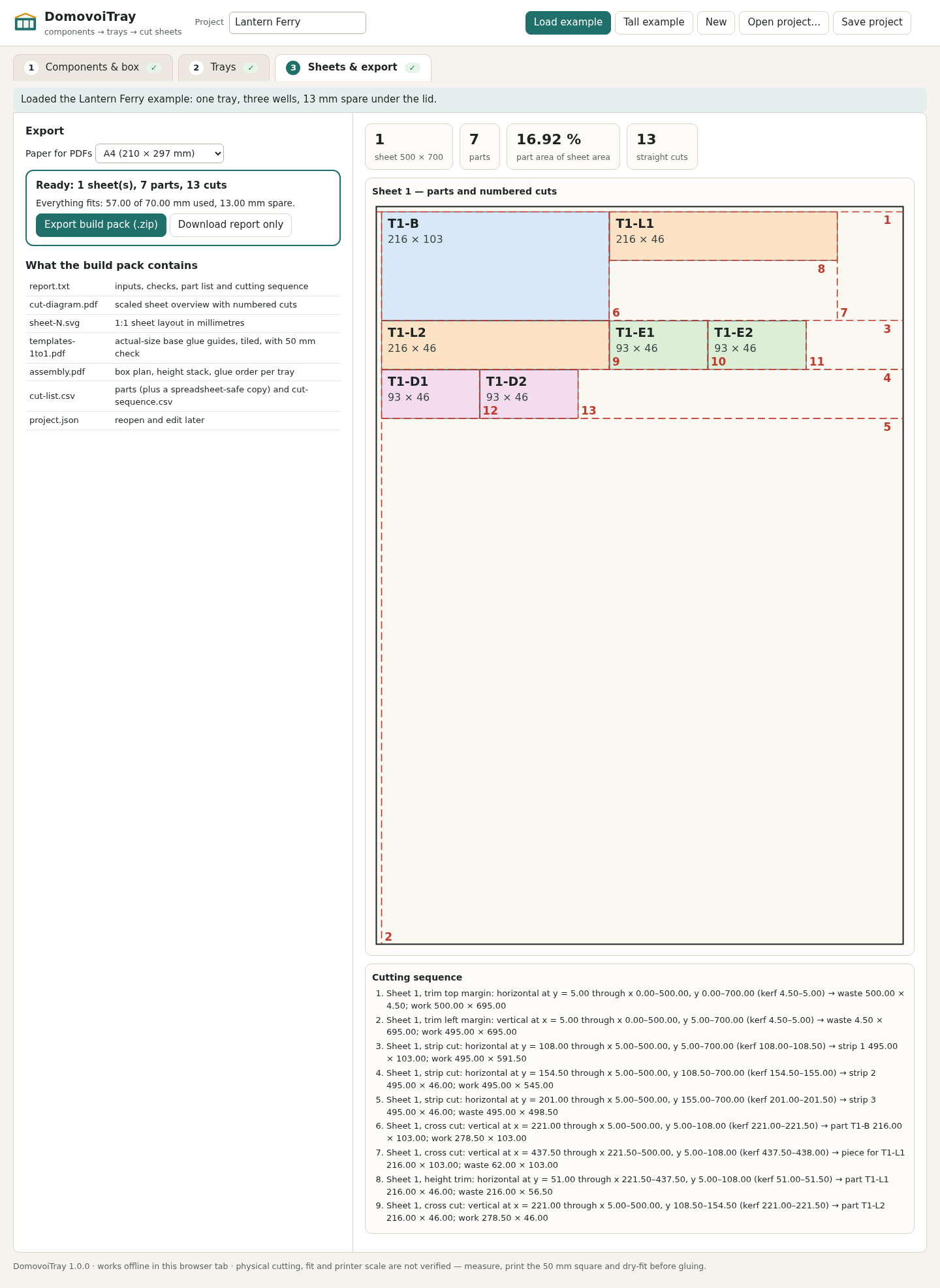
In the paid app, Load example → 3 Sheets & export generates the corresponding build ZIP. The SVG sheets use millimetres at 1:1. cut-diagram.pdf is a scaled overview with numbered cuts: do not take physical measurements from that PDF.
For actual-size glue guides, use templates-1to1.pdf on A4 or US Letter at 100% / Actual size. Measure its 50 mm test square before using any template. The tiled pages have 10 mm overlap. Check your printed guides and dry-fit the real components before gluing.
Use the example to check the inputs and save your work
For this article, an independent Decimal calculation read the exact free ZIP project files without using the application runtime. It reproduced the requested and actual wells, 216 × 103 × 51 mm normal tray, 57 mm stack, 13 mm spare and 59,232 mm² part area. The tall variant reproduced 67 mm, 73 mm and 3 mm excess. Separate release review checked the browser, exported geometry and cut sequence.
- Measure the inner box, actual board thickness and sleeved card stack.
- Include every board, rulebook and other lid item above the trays.
- Check actual shared-depth wells and floor positions, not only requested sizes.
- Use the actual-size template PDF; verify the 50 mm square at the printer.
- Choose Save project before closing and keep the downloaded JSON.
DomovoiTray supports rectangular single-row trays on one floor layer: no curves, lids, slots, multi-row or stacked trays. It accepts up to 12 trays, 40 components/wells and 20 sheets, with eight wells per tray. Read the full guide for file-size and dimension limits.
The tested environment is Chrome 152 on Linux, with A4 and US Letter output. Other systems and browsers, physical cutting, glue-up fit and actual printer scale are unverified. PDF text outside Western European Latin becomes ?; JSON and CSV keep the names. The app runs locally with no account or network requests, and project saving is explicit.
Perunlight product
Turn your measurements into a cutting pack
DomovoiTray sizes single-row rectangular trays, checks floor placement and the full lid stack, and exports numbered straight cuts with actual-size tiled glue guides.
DomovoiTray · $19 onceRead the guide
Extract the whole buyer ZIP and open DomovoiTray-1.0.0/DomovoiTray.html in desktop Chrome. Checked in Chrome 152 on Linux. Save projects explicitly; there is no autosave.