DomovoiTray · Local foamcore insert planner 1.0.0 · Chrome on Linux
Fit the components. Plan the cuts.
Plan rectangular board-game inserts from measured components, check the lid space and export a numbered cutting and assembly pack.
You want to build a rectangular foamcore or chipboard insert from measurements of your own game components.
$19 USD · one-time purchase
Continue to checkoutStep-by-step guide
No subscription. Final total and tax appear at checkout.
Check the example before buying
Inspect the three sample input files and written expected dimensions/cuts. The paid app generates build packs for your measurements.
- Size the wells: Turn measured decks and token piles into clearances, shared-depth wells and rectangular trays.
- Check the whole stack: Include the tallest tray, board, rulebook and top clearance under the lid.
- Follow a cut sequence: Place parts on your sheet size and export numbered straight cuts and glue guides.
What it helps you do
For tabletop designers and hobbyists making rectangular foamcore or chipboard inserts. Enter measured decks, token piles or fixed wells, arrange single-row trays on the box floor, and check the full height stack before generating parts and cutting guides.
What is in your download
- Local browser app and runtime source under the MIT license
- Illustrated English manual with five actual screenshots
- Original Lantern Ferry project, tall variant and component CSV template
- Export per valid project: SVG sheets, cut-diagram PDF, actual-size tiled glue-guide PDF, assembly PDF, CSV parts/cuts, report and editable project
A practical example
Lantern Ferry — original fictional insert
Start with
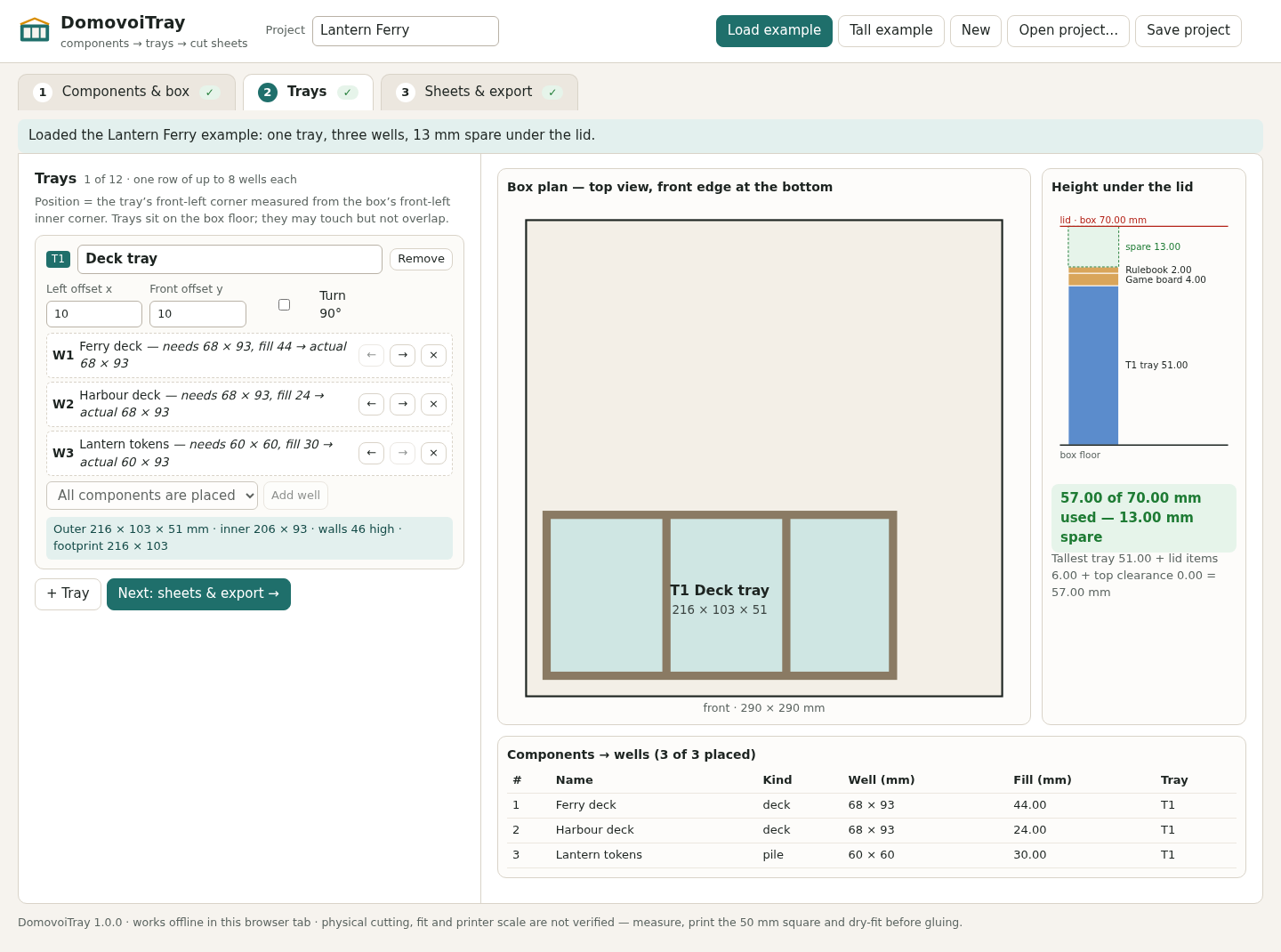
Two 66 × 91 mm sleeved decks: 110 and 60 cards at 0.40 mm per card; one 58 × 58 × 30 mm token pile; 1 mm side clearance, 2 mm headroom, 5 mm board and a 290 × 290 × 70 mm box.
Get this result
Normal: tray 216 × 103 × 51 mm, total height 57 mm and 13 mm spare; seven parts total 59,232 mm². Tall variant: 67 mm tray, 73 mm stack, 3 mm excess. The examples are digital checks, not proof of physical fit.
Free illustrated manual, source JSON/CSV and written expected dimensions/cuts (no app)
Examples use fictional or synthetic data. Follow this example step by step.
From measurements to a checked cutting pack
Actual DomovoiTray screens in Chrome on Linux. Lantern Ferry is an original fictional example.
Check the tray and the lid space
The fictional Lantern Ferry tray is 216 × 103 × 51 mm; the complete stack uses 57 of 70 mm, leaving 13 mm. View full size Follow the parts and numbered cuts
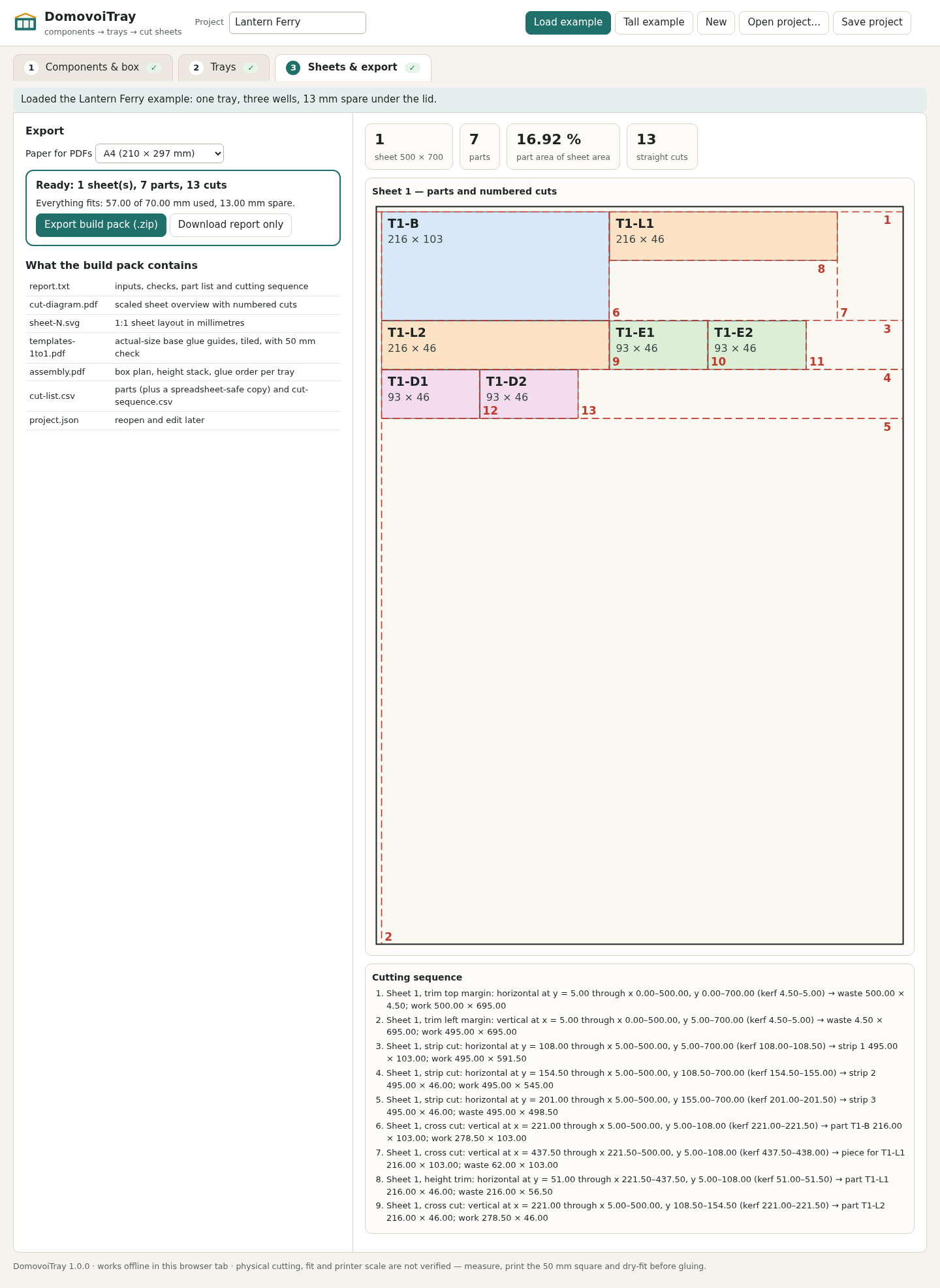
The example uses one 500 × 700 mm sheet, seven rectangular parts and 13 straight cuts. Part area excludes kerf and waste. View full size Catch a stack that is too tall
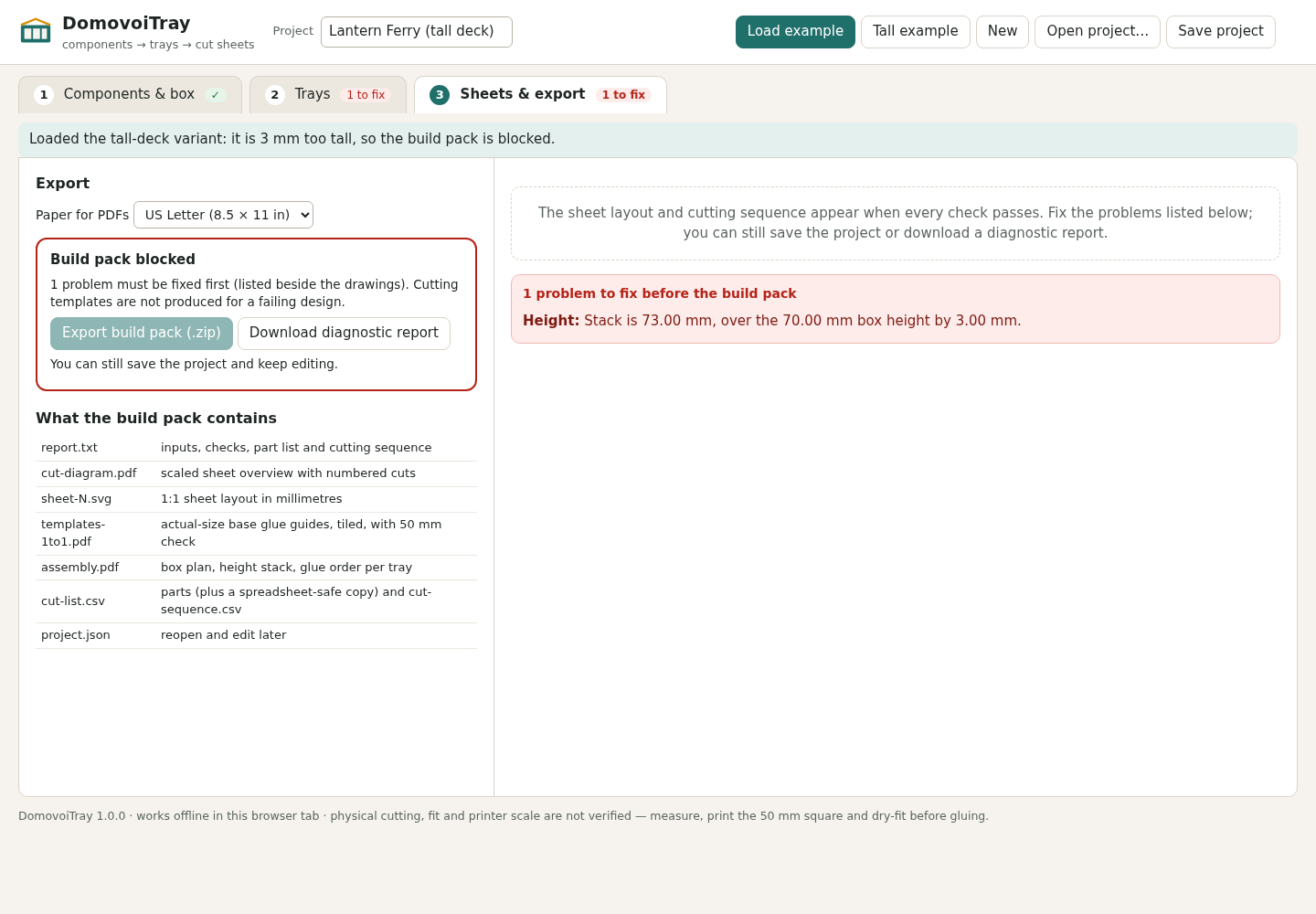
Increasing the Ferry deck to 150 cards makes the stack 73 mm. The build pack stays blocked until the 3 mm excess is resolved. View full size
How it works
Measure and enter
Record the box, components, material, kerf, sheets and lid items.
Arrange and check
Put wells in single-row trays and check floor positions and height.
Save and build
Save the project, export a valid build pack and verify print scale before cutting.
Before you buy
- Desktop Google Chrome; checked in Chrome 152 on Linux. Other platforms are unverified.
- Extract the buyer ZIP and open DomovoiTray-1.0.0/DomovoiTray.html in desktop Google Chrome. Keep the adjacent JavaScript and CSS files together. No installation, account, server or internet connection is required.
- A ruler or calipers, inner box measurements and measured board thickness; include sleeved-card caliper and all items under the lid.
- A4 or US Letter printing for actual-size glue guides, with a verified 50 mm test square.
Compatibility & limits
Rectangular foamcore or chipboard parts, single-row trays and one floor layer only. No curves, slots, half-laps, lids, multi-row trays, stacked trays or 3D-print output. Wells in the same tray share its full inner depth; a requested 60 × 60 mm well can become 60 × 93 mm beside deeper wells. Up to 12 trays, eight wells per tray, 40 total wells and components, 10 lid items and 20 sheets; at most 88 parts. Each component can occupy one well. Trays may touch but cannot overlap or extend outside the measured inner box. Project JSON up to 1 MiB; UTF-8 comma-separated component CSV up to 512 KiB and 40 rows. Use the supplied headers and quote embedded delimiters. Rejected imports leave the project unchanged. Dimensions use 0.01 mm precision; inch inputs convert at 25.4 mm per inch and round half-up. Enter measured material thickness, component sizes, kerf, clearance and lid items. The app cannot detect unentered items or inaccurate measurements. Sheet placement uses a deterministic shelf method and may rotate parts 90 degrees. It does not find an optimal layout. The part-area percentage excludes kerf and waste; it is not a promise of material savings. The cut-diagram PDF is a scaled overview: do not measure parts from it. The templates PDF supplies actual-size tiled glue guides on A4 or US Letter with 10 mm margin and overlap, a 50 mm test square and check bars. Print at 100% / Actual size and measure the square before use. Physical cutting, real material thickness, glue-up fit and printer scale are unverified. Dry-fit components and check your actual tools and material before gluing. The dimension checks evaluate the supplied numbers. PDF names outside Western European Latin are replaced with ?. Project JSON and CSV retain names exactly. SVG sheet layouts use millimetres at 1:1. No other paper sizes were tested. Save project downloads an editable JSON copy. There is no autosave, account or cloud sync. Runtime files make no network requests; selected input files are not modified. Keep backups before closing. Independently checked in Chrome 152 on Linux with desktop and 390px layouts and A4/Letter output. Other browsers and operating systems are unverified. Desktop authoring is recommended. The buyer package includes runtime source under the MIT license. The free pack contains the illustrated manual, source examples and written expected arithmetic/cuts; it does not contain the app or generated build-pack PDFs/SVGs.
Get DomovoiTray
Perpetual use of the purchased version on your devices for personal or internal commercial work. Keep reasonable backups and modify your own copy; do not redistribute or resell original proprietary code. Third-party licenses and any existing preview permissions retain their rights.
Before payment, save the private recovery code shown by checkout. After Paddle confirms payment, use it to download your ZIP or return for it later. No subscription, future update or email delivery is promised. See the illustrated steps.
$19 USD · once
Buy download