Step-by-step guide
SindriLot
Keep pottery batches connected to the orders they filled. Allocate firsts and seconds, trace a batch in either direction, and prepare remake sheets from your own records.
You make repeat pottery forms and need a local record of batch outcomes, order allocations and the reference batch for a later remake.
Before you start
- Extract the full buyer ZIP, then open sindrilot.html in desktop Google Chrome. Chrome 152 on Linux was tested; other browsers and operating systems remain unverified.
- No account, server or internet connection is needed. Browser storage is convenient working storage; keep downloaded studio archives as backups.
- Use your own labels and records for clay, glaze, firing and measurements. The app gives no material, firing, food-safety or compliance guidance.
Your first result
Open the fictional studio
Open sindrilot.html and choose Open sample studio. Oak Lane contains three batches, five order lines and an original labelled fixture drawing attached to batch M1.
Try a refused allocation
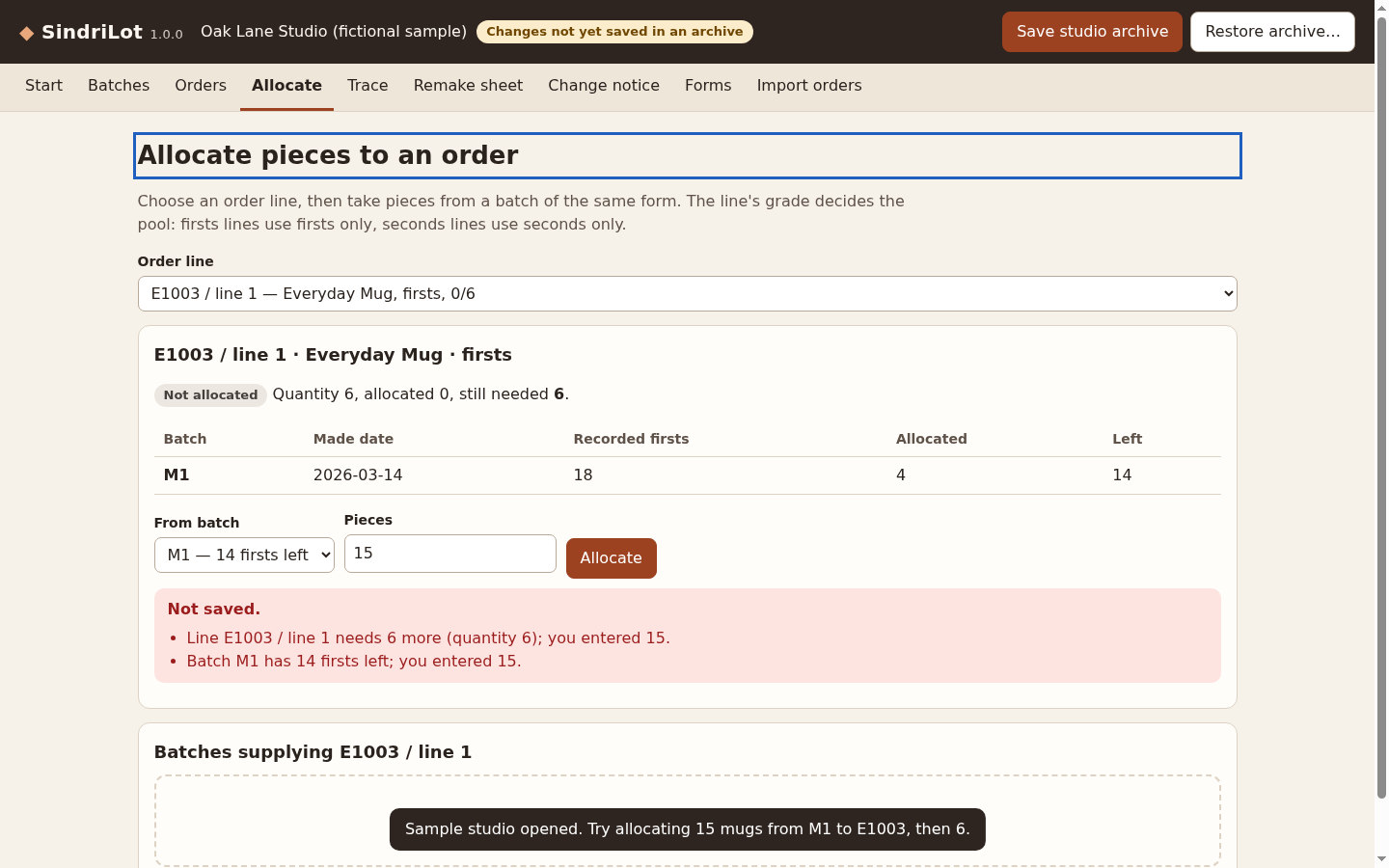
On Allocate, keep order E1003, choose M1, enter 15 pieces and press Allocate. The app refuses both excesses: the line needs six and the batch has fourteen firsts left.
Allocate the six mugs
Enter 6 and allocate. M1 now has 8 firsts and 1 second left. P1 has no firsts left and P2 has eleven.
Trace the plates
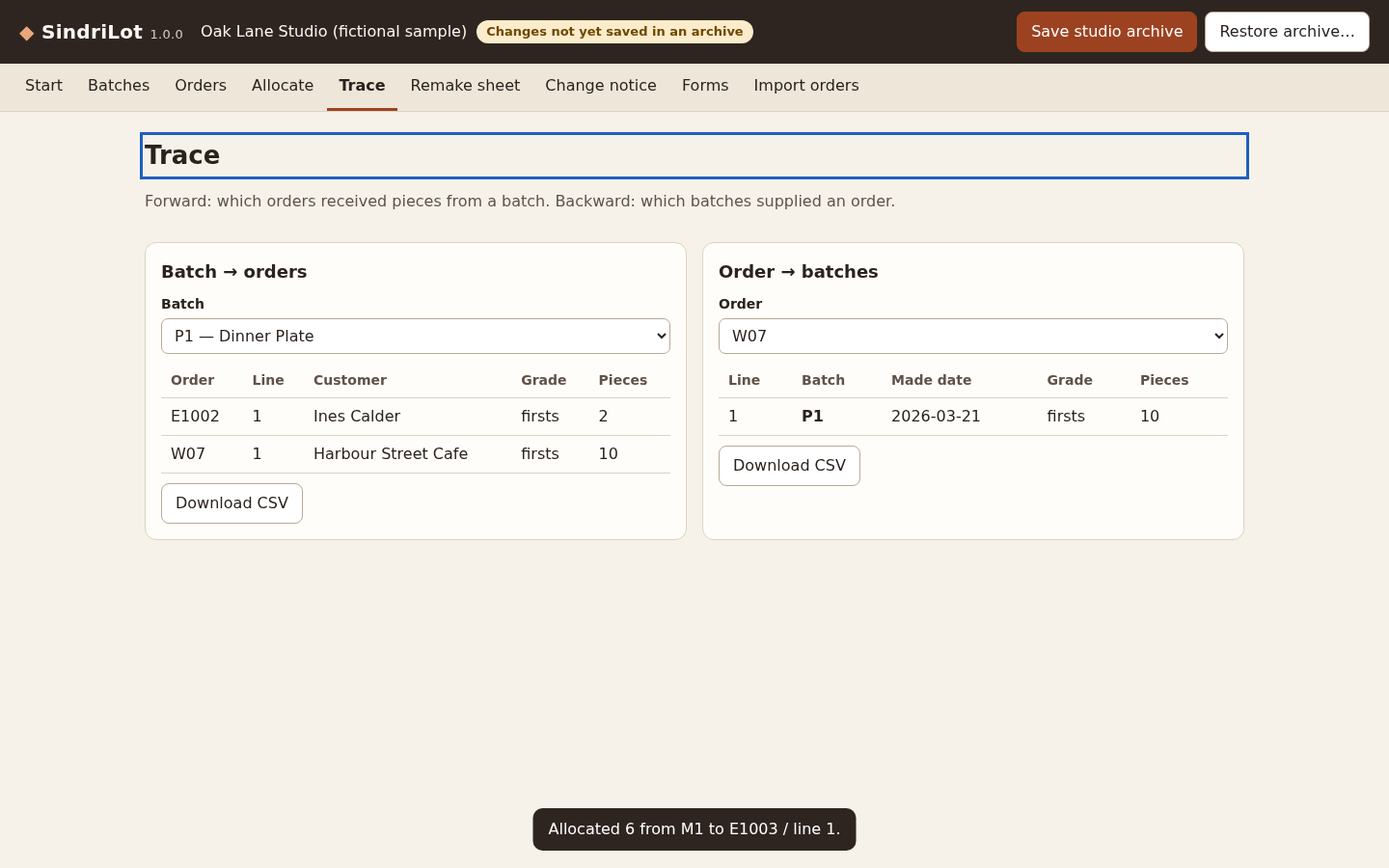
Open Trace, choose batch P1 and order W07. P1 supplied ten plates to W07 and two to E1002; W07 came from P1. Download either CSV view if needed.
Prepare the remake sheet
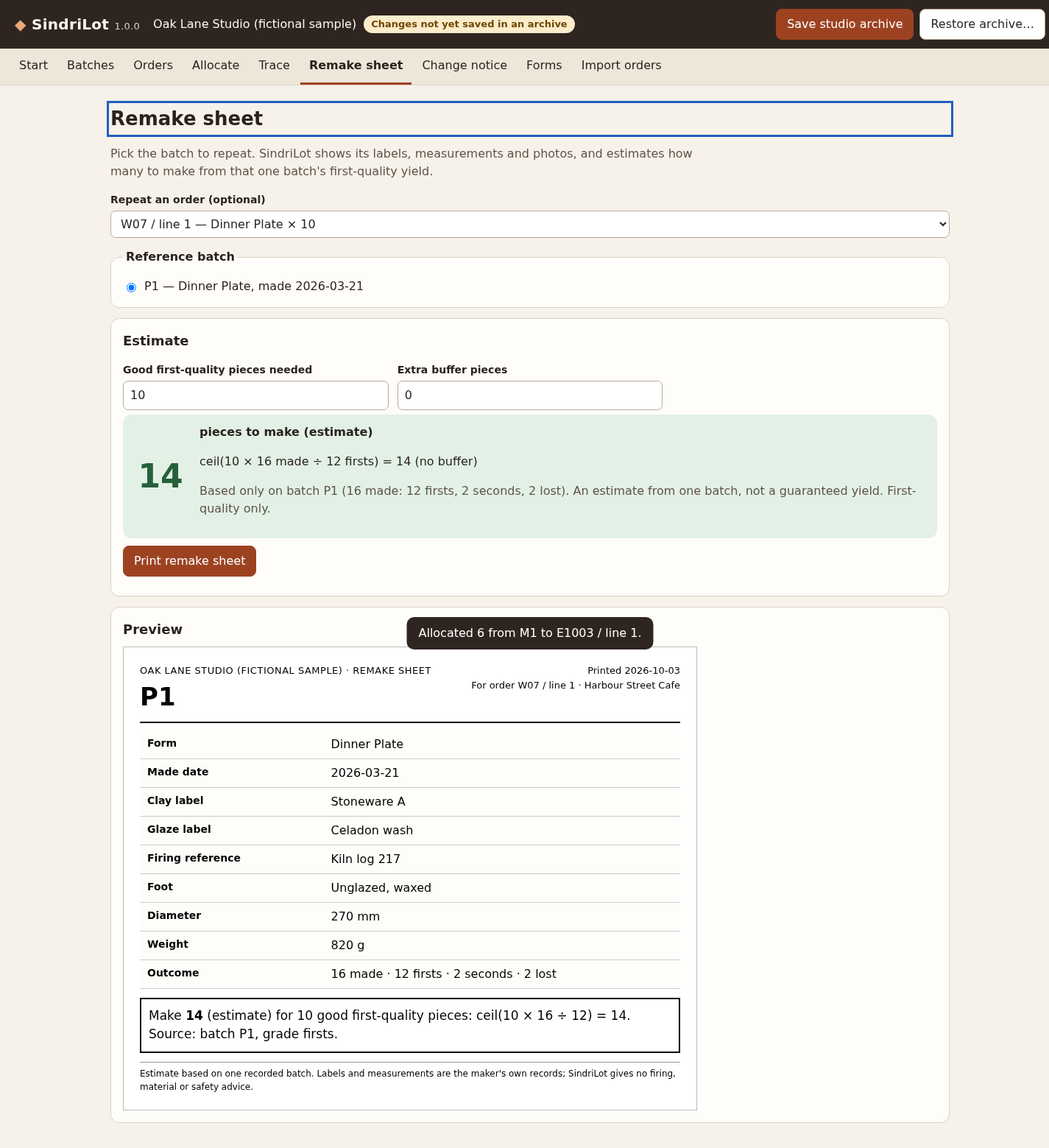
On Remake sheet, choose W07. P1 is the reference. Ten first-quality plates at its recorded 12-of-16 yield gives ceil(10 × 16 ÷ 12) = 14 pieces; a buffer of two gives 16. Inspect and print the reference sheet.
Compare the next batch
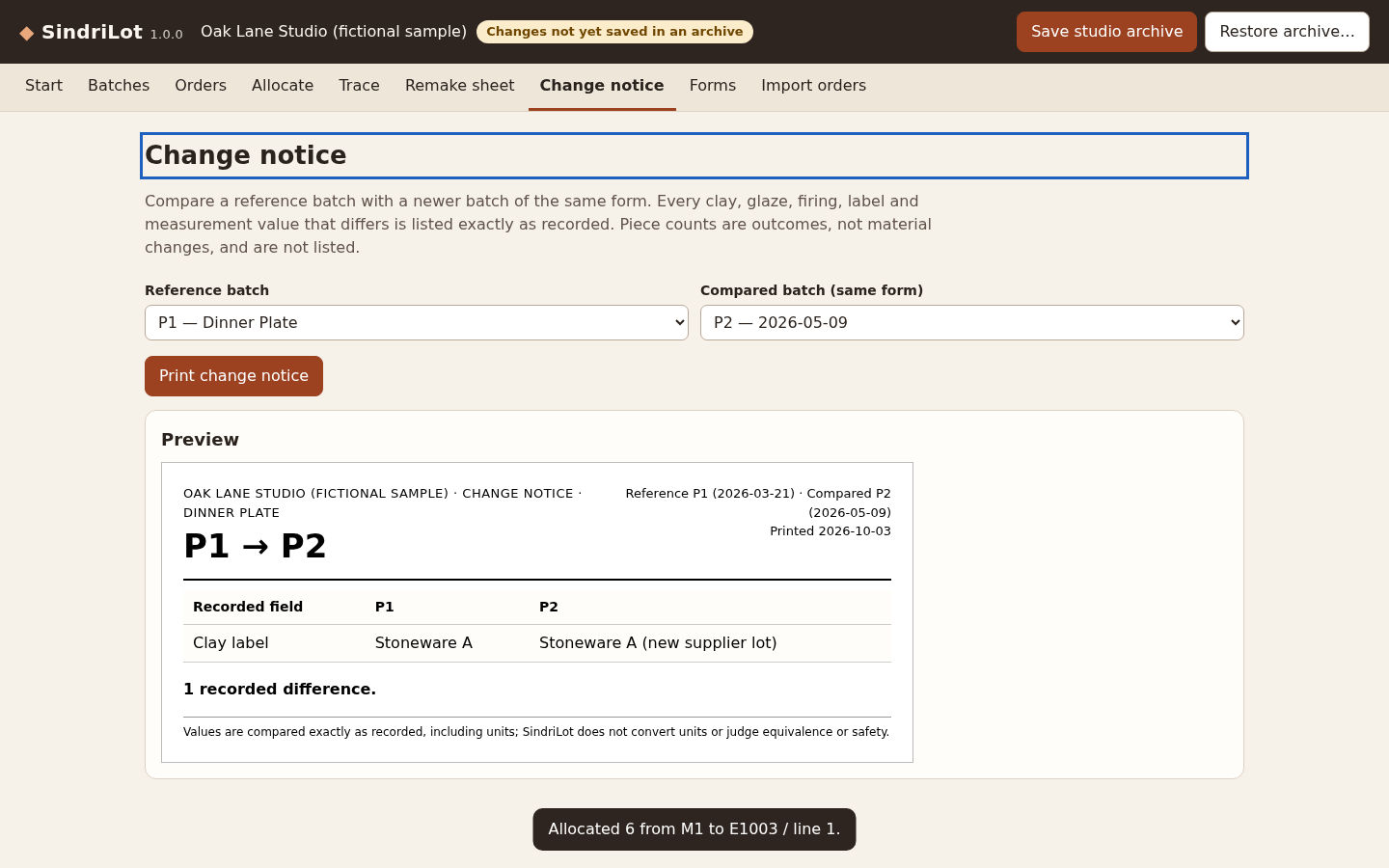
Open Change notice and compare P1 with P2. Expect one recorded difference: the clay label. Outcome counts are not treated as material changes.
Save and restore
Choose Save studio archive. Keep that ZIP unchanged. To move the work, open the app in another browser, choose Restore archive…, inspect the summary and confirm replacement. The sample archive included in the ZIP reflects this completed walkthrough.
Record your own studio
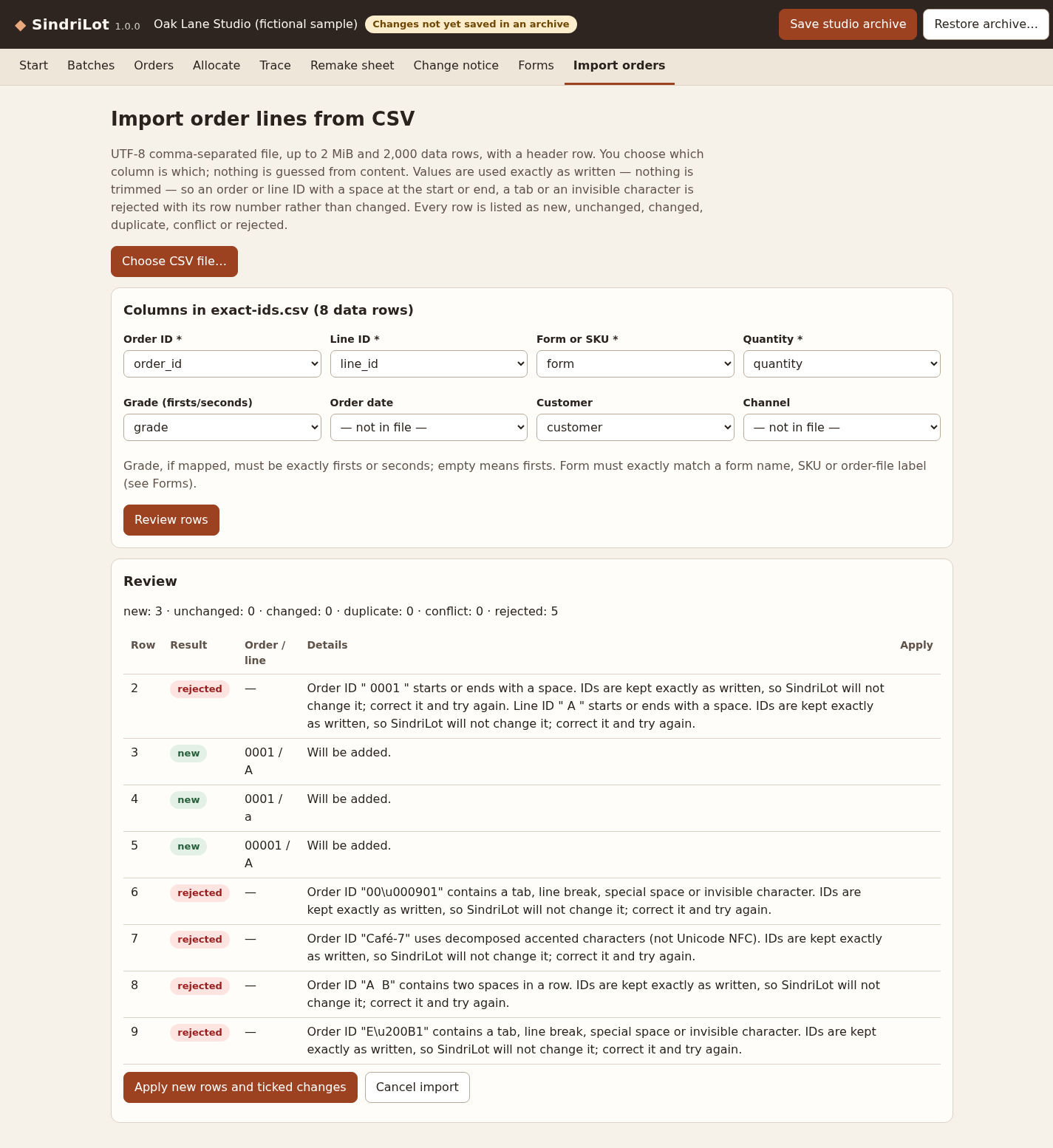
Start an empty studio, define forms, add batches and order lines, and allocate pieces. CSV imports use your column mapping and show every row decision. Valid IDs keep case and leading zeros; IDs with edge spaces or invisible characters are refused for you to correct.
A worked example
Oak Lane Studio — original fictional batch records
Input: Fictional Oak Lane Studio: M1 mug 24 made/18 firsts/4 seconds/2 lost with a labelled fixture diagram; P1 plate 16/12/2/2; P2 plate 12/11/1/0 (clay label changed). Orders E1001 (4 mugs), W07 (10 plates), E1002 (2 plates), E1003 (6 mugs), S2001 (3 seconds mugs).
- Refuse the 15-piece allocation, then allocate six from M1 to E1003.
- Trace P1 and W07; calculate the remake with buffer zero and two.
- Compare P1 with P2, then save and restore the whole studio.
Expected result: 15 mugs to E1003 refused (line needs 6; M1 has 14 firsts left); after allocating 6, firsts left M1 8, P1 0, P2 11 and M1 seconds left 1. Trace P1 → W07 10, E1002 2; W07 → P1 10. Remake 10 plates from P1 = 14 (16 with buffer 2). Change notice P1 → P2 lists only the clay label.
A record that follows the work
Actual SindriLot screens in Chrome on Linux using the fictional Oak Lane Studio.
1. Check available pieces
2. Trace both directions
3. Prepare a repeat order
4. Explain a recorded change
5. Review incoming orders
Troubleshooting
"Batch … has N firsts left; you entered M"
Enter a smaller number or choose another batch of the same form.
"… recorded N but M are allocated" when lowering a count
Remove or reduce the listed allocations first.
Remake sheet says pieces are unrecorded
Record every made piece as firsts, seconds or lost in the reference batch.
Import row: form does not exactly match
Add the exact text as an order-file label on the form, or correct the CSV.
Import row: Order ID … starts or ends with a space (or contains a tab or invisible character)
Correct that ID in the spreadsheet and import again; SindriLot never trims or rewrites IDs.
"The file is not valid UTF-8"
Save the spreadsheet as CSV UTF-8 (comma delimited).
"This studio was changed in another tab"
Reload the page to load the latest saved studio.
Restore refused
Use the archive exactly as SindriLot saved it; the message names the failing entry.
Compatibility & limits
- Tested only in Google Chrome 152 on Linux (desktop and 390 px narrow window); other browsers and operating systems are untested.
- Per studio: 200 batches, 2,000 order lines, 4,000 allocations, 100 forms, 32 photos. Photos: JPEG/PNG ≤1 MiB, ≤12 megapixels, 4 per batch.
- CSV import: UTF-8 comma-separated, ≤2 MiB and ≤2,000 data rows per file. No marketplace presets; not verified against any shop's export format.
- Order ID ≤64 and line ID ≤32 characters, kept exactly; IDs that start/end with a space or contain tabs, line breaks, invisible characters, double spaces or decomposed accents are rejected rather than cleaned up.
- Archive restore: ≤40 MiB, ≤100 entries, exactly as saved by SindriLot (re-zipped copies are refused). The SHA-256 manifest detects accidental changes; it does not prove authorship.
- Remake estimates are first-quality only, from one recorded batch, and need every made piece recorded; they are not guaranteed yields.
- Data is stored in this browser for convenience; browser storage can be cleared, so save a studio archive regularly.
- Printing was verified as PDF output only; no physical printer was tested.
- No firing, recipe, material, food-safety, product-safety or compliance guidance; no stock, accounting or shop integration.
- Photo originals and filenames are retained. Inspect archives before sharing them.
Need a hand?
Tell us the product, host application and version, what you tried, and the exact error. Contact support with a fictional example; keep private customer files and passwords out of your message.